Showing posts with label List. Show all posts

Sunday, February 24, 2013

Best of 2012: My Top 5 Movies of 2012

Here are my Top 5 Favorite Movies of 2012. (I’ve also included one Wildcard Pick and an Honorable Mention so I suppose altogether this is my Top 7.)


My wildcard pick this year is Oliver Stone’s addictive, blistering Savages about the weed business. Depending on how you look at this brash and reckless movie, you may deem it a frustrating failure or an exhilarating entertainment. Then again, why choose? Oliver Stone does the equivalent of bringing an Uzi to an archery range. He makes quite the mess of things but you can’t say he doesn’t hit his target. The movie is too long and the ending is a strange, ungainly disaster but I can’t say that any other movie this year shocked or thrilled me more. If you’re looking for the most bang for your buck, look no further.


Honorable Mention: Argo (Original Review)

A terrific audience-pleaser and perhaps the best thriller of the year, director Ben Affleck’s Argo is great, edge-of-your-seat entertainment. It tells the absurd, true story of a CIA mission that faked a movie production to retrieve a group of American citizens during the 1979 Iranian hostage crisis. The movie acknowledges the fraught international politics of the time but is first and foremost a daring rescue movie. This one is loads of fun and smart to boot.


At the end of The Master there are loose ends left untied and mysteries that go unexplained. Frustration with the film’s anticlimax and lack of a resolution is perfectly natural. But part of the fun of this movie – and this is assuming you share my idea of fun – is sifting through this strange and fascinating drama and guessing at what it could all possibly mean.

This is not to say the film is some sort of scholarly exercise; it’s much better than that. Watch the bizarre bond that forms between a mentally unstable WWII veteran named Freddie Quell (Joaquin Phoenix, unhinged and with a wild look in his eye) and Lancaster Dodd (Philip Seymour Hoffman, never better), the charismatic leader of a dubious New Age church. Their relationship twists and turns as the two men gain power and leverage over one another. The Master is a half-mad swirl of sexual impulses, pseudo-scientific babble and violent outbursts. I can’t say I understood it all but I was never bored.


There are a number of thorny issues at play in Zero Dark Thirty – the use of torture on political detainees, the gender politics of women in government – but the heart of the film drives at a larger, more encompassing question: Is the ultimate objective of the War on Terror to protect the homeland from future attacks or to punish those responsible for 9/11? For Maya (an intensely focused Jessica Chastain), the distinction is irrelevant. Either way the goal is the same – take out Osama bin Laden.

The film is a historical approximation of the leads and events that resulted in bin Laden’s death on May 2, 2011, but what elevates it beyond the level of a made-for-TV movie is director Kathryn Bigelow’s remarkable craftsmanship and eye for poetic detail. The final assault on bin Laden’s compound – a flurry of night vision green and fiery explosions set against the darkness of night – is as tense as any action movie. When the dust clears, the human drama ends on a note of bittersweet uncertainty. Whether bin Laden was killed for the sake of homeland security or justice may not matter from a military perspective but emotionally how does one reconcile the two and move on?


3) Amour

Amour is a movie of few words so it seems wrong to use too many here to describe its greatness. This quiet, poignant love story follows an elderly couple as the husband grapples with the deteriorating health of his wife. Through the keen direction of Michael Haneke the film reveals intimate depths of its characters’ emotional lives often with little or no dialogue.

Amour is a devastating study of life and love in its final stages. It explores the difficulty of dying with dignity and of finally letting go when the time is right, but it is not all doom and gloom. Few movies are this honest and true. Every moment in it feels real and its message is ultimately life affirming.


There’s no sense in hiding it. Director Steven Spielberg and screenwriter Tony Kushner’s Lincoln is a history lesson. But what this impressive, entertaining movie shows us is that the participants of history were real people with large personalities, not some culmination of dates and facts like our high school curriculum might have us believe. They were politicians who were as prone to grandstanding and as stubbornly biased as today’s elected officials are. Lincoln’s thirteenth amendment to the Constitution, which abolished slavery, was an ambitious piece of legislation and its passage required bravery and political cunning, but also bribery.

There is no mistaking that Lincoln is a Steven Spielberg prestige picture – it is beautifully shot and features a slew of exceptional performances that will no doubt make the Oscar voters swoon – but it is also vibrant and alive in a way few period pieces are. Abraham Lincoln and the congressmen of his time understood they were making history but for them it was a very real present where victory was far from certain. History lessons are rarely as fascinating and exciting as this one.


Moonrise Kingdom has the warm feel of a half-forgotten childhood memory and director Wes Anderson brings it to life with the visual whimsy of a picture book. The movie breezes by, telling the story of Sam and Suzy (Jared Gilman and Kara Hayward, each pitch perfect), two lovesick kids who run away from home to be with one another. They are mature beyond their years and yet also heartbreakingly naïve, blissfully unaware of the crushing reality that awaits them outside the bubble of childhood.

This sad fact of life is not lost on the other inhabitants of the small New England island where the film takes place. The remaining cast of characters, a motley crew of melancholic grown-ups, drift in and out of the picture, desperate to find Sam and Suzy while also preoccupied with their own adult problems. Wes Anderson and Roman Coppola’s script finds bittersweet humor in their characters’ lives but never condescends to them. This blend of comedy and pathos is a delicate balancing act but Wes Anderson and his terrific cast – including Frances McDormand, Bill Murray, Ed Norton and Bruce Willis – walk the tightrope wonderfully.

Much like the private cove its young heroes discover and seek refuge in (and also gives the film its name), Moonrise Kingdom is an inviting paradise. One visit is not enough.

- Steven Avigliano, 2/24/13

Saturday, February 23, 2013

Best of 2012: My Favorite Performances

The Oscars have it all wrong. By trying to determine “the objective best” performances of the year, the same sorts of roles get nominated year after year and a lot of strong work gets overlooked. What follows are my favorite performances of 2012. Are they the best? I’m not sure I even know what that means. These are the performances that made bad movies decent and good movies better. These are the actors I was talking about with my friends as I left the theater. These are the ones I’m still thinking about.

I’ve listed them in alphabetical order, selecting one as my favorite of the year and one bonus prize for the best ensemble.

Josh Brolin – Men in Black 3
Doing his best Tommy Lee Jones impression, Josh Brolin as Agent K’s younger self was the highlight of the second, time-traveling sequel to Men in Black. He may even play the straight man to Will Smith even better than Jones did. Getting laughs with nothing more than a mean mug and a dry Southern drawl, Brolin made this thoroughly unnecessary movie a pleasant surprise.

Daniel Day-Lewis – Lincoln
At the heart of Steven Spielberg’s superb film is Daniel Day-Lewis’s portrayal of Abraham Lincoln. He disappears into the role as he always does but he doesn’t dominate the movie. The performance is low-key, painting the former president as a thoughtful, intellectual man. Of course, Lincoln is known as a great orator and Day-Lewis gets a few moments to shine in this capacity. But note also the quieter moments when he jokes with cabinet members or discusses with his wife the fate of their enlisted son. The performance is another in a line of great ones in the actor’s impressive career.

Andrew Garfield – The Amazing Spider-Man
There’s a moment in The Amazing Spider-Man when Andrew Garfield shakes his head, grinning, mouth agape, apparently speechless. I imagine I’d look much the same way were I lying in the arms of Emma Stone while she tended to my wounds. Garfield is thoroughly convincing as a teenager suddenly given super powers – a little cocky and a little clumsy but well intentioned. His Peter Parker is a charmer in a way Tobey Maguire never was in the role and his performance helped make The Amazing Spider-Man the most fun I had at the movies this summer. 

Salma Hayek – Savages
A wildly over-the-top Salma Hayek devours her role as a drug kingpin in Oliver Stone’s Savages. Cursing in two languages and wearing some fantastic wigs, she gives a movie that is already high off its own supply an added jolt of adrenaline.


Yes, Anne Hathaway steals the show with her stellar rendition of “I Dreamed a Dream” in Les Misérables, but I enjoyed her turn as the sexy, wise-cracking seductress Selina Kyle (a.k.a. Catwoman) in The Dark Knight Rises even more. The movie, which very nearly collapses under the weight of its own seriousness, is actually a lot of fun whenever she’s on screen and if there’s one thing it could have used more of, it’s her.

Philip Seymour Hoffman / Joaquin Phoenix – The Master
Any interpretation of Paul Thomas Anderson’s maddening new film hinges on how you view the relationship between Lancaster Dodd (Hoffman) and Freddie Quell (Phoenix). Is their bond that of a father to his son? A teacher to his pupil? A scientist to a lab rat? All of the above? Each actor makes his part nuanced and complex. We can never pin these men down and this inability to fully understand their relationship is what makes the movie so compulsively fascinating.

Samuel L. Jackson – Django Unchained
In a film that mostly ignores the complexity of race relations in the Old South, Samuel L. Jackson fearlessly digs into some very tricky material as Stephen, the loyal servant of a cruel and violent plantation owner. He is frighteningly intense but, being a Tarantino veteran, Jackson is more than capable of navigating the sudden tonal shifts from drama to comedy and back. Stephen is a fascinating variation on the Uncle Tom archetype, muddying the waters of Tarantino’s overly simplistic morality and enlivening the movie’s last act.

Jennifer Lawrence – Silver Linings Playbook
A far cry from her solid-as-a-rock performance as Katniss Everdeen in The Hunger Games, Jennifer Lawrence shows off her range playing the romantic foil to a manic depressive Bradley Cooper. She is emotionally guarded and prone to mood swings but watch how her face shows you everything her character is thinking and hints at the sudden outbursts just before they happen.

Channing Tatum – 21 Jump Street
Channing Tatum is hilarious. Who knew? He has comedic timing to match his good looks and his presence here helps freshen up Jonah Hill’s fast-talking shtick in one of the year’s most unexpectedly funny movies.


My Favorite Performance: Martin Freeman – The Hobbit: An Unexpected Journey
If Peter Jackson’s first Hobbit movie wasn’t quite perfect, there was at least one aspect of it that was: Martin Freeman’s Bilbo Baggins. Freeman gets the part exactly right. His Bilbo is a homebody, curious about the outside world and with an impish streak in him, but mostly content to curl up by the fire with a good book. Whenever the movie threatens to get lost in a computer-generated frenzy, Freeman can be counted on to right the ship’s course. Though he is too often relegated to the sidelines in this first film, the next two parts of the trilogy would be wise to turn to Mr. Baggins more often.

Best Ensemble – Moonrise Kingdom
The cast Wes Anderson collects for his latest feature is an enviable one. Some of them play roles we’re familiar seeing them in. Bill Murray is as reliable as ever playing a sad sack and Frances McDormand is a joy to watch as his wife, a Type A personality who wears the pants in the family. But others play refreshingly against type. Ed Norton is a lot of fun as a scout leader who is still a boy at heart and Bruce Willis is touching as a lonely police officer. Add to that some fine supporting roles from Bob Balaban, Harvey Keitel, Jason Schwartzman and Tilda Swinton, not to mention some excellent young newcomers (including Jared Gilman and Kara Hayward as the eloping young lovers), and you have an excellent ensemble led by Wes Anderson, one of the best maestros around.

- Steve Avigliano, 2/23/13

Saturday, February 25, 2012

Best of 2011: My Top 10 Movies of 2011

The list below is of my favorite movies of 2011. I wrote the other day how determining the best movies in a given year can be tough because you can’t always tell whether or not a film will age well. Some movies get better and better the more you watch them. Others make a great first impression but might not hold up to multiple viewings. This list is a collection of first impressions. These are all movies that left a mark on me the first time I saw them. I’ll check back with them a few years down the road and see how they hold up.

In the meantime, most are on DVD or will be soon (and The Descendants is still in theaters now). So use the on demand/online streaming/DVD-in-the-mail service of your choice and check them out. (I’ll also share with you a well-kept secret of where to rent movies that I use all the time: the library. Most local libraries have large movie collections and get all the new DVDs. You might have to fight with the woman down the block who has a crush on Ryan Gosling in order to get your hands on a copy of The Ides of March but, hey, it’s free.)

Before we get to the Top 10, here are five films I admire that didn’t make the list: Another Earth, The Future, The Girl with the Dragon Tattoo, Moneyball, Terri

Woody Allen’s globetrotting continues with Midnight in Paris, a breezy, time-traveling comedy starring Owen Wilson who, in a fine performance, splits the difference between his own comic persona and the neuroses of Mr. Allen. Those familiar with the major figures of art and literature in 1920s Paris (Ernest Hemingway, Gertrude Stein and Salvador Dali, to name a few that appear here) will be delighted but you don’t have to get all the references to enjoy the film. Mr. Allen’s own love of these artists shines through every scene and Mr. Wilson is great fun to watch as he marvels at being transported to the bygone era he adores. A love letter to the city and a bittersweet (though mostly sweet) study of how nostalgia afflicts us all.

Take Shelter is an absorbing psychological thriller about a blue collar Midwesterner, Curtis LaForche (Michael Shannon), on the cusp of a schizophrenic breakdown. Or is he? He begins having horribly realistic nightmares of an apocalyptic storm but are the dreams premonitions of some rapture to come, or is his mind descending into madness? Neither option bodes well for him and his family. The film, written and directed by Jeff Nichols, is engrossing because Curtis’s supernatural fears have real world consequences. When he becomes obsessed with renovating an old tornado shelter in the backyard, the expenditure puts a significant financial burden on his family. This is a beautifully shot, gradually paced and absolutely gripping movie.

A Dangerous Method follows the professional and personal relationship of psychologists Carl Jung (Michael Fassbender) and Sigmund Freud (Viggo Mortensen) but this is not a typical historical biopic. This is an exceptionally talky film; Jung and Freud’s discussions on the subtleties of psychoanalysis are only occasionally broken up by scenes of kinky sex between Jung and his patient-turned-student-turned-lover, Sabina Spielrein (Keira Knightley). Despite the dry nature of the material though, there is a current of excitement running through A Dangerous Method. These were intellectual innovators on the verge of changing the way the world thought about the human mind and director David Cronenberg elegantly captures that moment in this fascinating film.

Alexander Payne’s films tell wonderful, human stories. Like previous Payne features Sideways and About Schmidt, The Descendants depicts a man facing a personal crisis, and does so with compassion and humor. After a boating accident puts his wife in a permanent coma, Matt King (George Clooney) is left alone to father his two daughters. Meanwhile, as the lone trustee to a huge estate, he faces pressure from the other side of his family to find a buyer for the property. The movie, set against a gorgeous, Hawaiian backdrop, has a keen sense of culture and history. It also ends on what might be my favorite final shot in a movie this year.

The definition of what is cool is always changing and often we can look back and identify what sparked certain trends in coolness. Attack the Block is the sort of movie we’ll look back on and say, “Oh, yeah. That’s cool because Attack the Block did it first.” The movie follows a teen gang in inner city London who unwittingly find themselves fighting off an alien invasion. What’s kind of brilliant about it is that they react to this extraterrestrial contact precisely how you’d expect a bunch of fifteen-year-old boys to. When they kill their first alien, what do they do? They drag its carcass through the streets and show it off to a few girls before bringing it to the guy they buy weed from. Fast-paced, funny, sometimes gory, and featuring impressive creature effects. A promising debut from writer/director Joe Cornish.

An analyst for a powerful financial investment firm is laid off but before he leaves the building he hands a flash drive to one of his employees. “I think you should take a look at this,” he says. “Be careful.” That’s the set-up of Margin Call, which mostly takes place over one night as the gravity of the information on that drive sinks in – it contains calculations that predict the firm’s doom – and news travels up the ranks to the CEO. This is a tense film inspired by the 2008 financial crisis and successfully makes complex concepts accessible without dumbing them down. Writer/director J.C. Chandor seeks to do nothing less than question the morality of capitalism but never demonizes his characters. Instead, he invites us to ask ourselves: What would I do in this situation? Is jumping ship and saving myself the right thing to do? Characters in the film are always asking this but the notion of what is “right” turns out to be a very murky concept indeed.

4) Warrior
This is a powerful story about two estranged brothers – tormented Iraq War veteran Tommy (Tom Hardy) and Brendan (Joel Edgarton), a physics teacher and father of two – who return to their roots as mixed martial arts fighters. Tommy enlists the help of his father (Nick Nolte), a reformed alcoholic and Tommy’s former trainer, to prepare for an upcoming tournament. Brendan, meanwhile, starts participating in pickup matches to make quick cash and stall foreclosure on his house. You might be able to guess where this is going but Warrior is impressive in the way it does not simplify its characters’ complex relationships while still adhering to the crowd-pleasing formula of the fight genre. Audiences largely dismissed Warrior because of seeming similarities to The Fighter, an unfair fate considering it is even better than that film. This one blew me away.

Higher Ground chronicles one southern woman’s relationship with religion, from her tenuous beginnings with evangelicalism and following her as she is born again and subsequently questions her faith. Though it features a fair amount of preaching, the movie itself never preaches. It approaches its characters with a critical eye and its subject matter with an open mind. Vera Farmiga, who stars in the film and makes her directorial debut, is careful not to condescend. Some members of the congregation are naive and old-fashioned but all of them are complex individuals, not stereotypes. The film shoulders big topics – sex, marriage, family, church and the role women play in all of those – but does so gracefully and without passing judgment. This is a quiet movie about the process of self-discovery; there are few grand, dramatic moments in it. Yet, in its subtle way, the film uncovers something true and leaves a lasting impression.

Tone can be a delicate thing. Mike Mills’s Beginners finds just the right one though; it has an emotional frankness that does not soften its more tragic moments but also has a certain whimsy and love for life that is infectious. We meet Oliver (Ewan McGregor) at the start of a new relationship with Anna (Mélanie Laurent), a French actress he meets at a party. This is intercut with remembrances of his late father (Christopher Plummer) who, in the last years of his life, was diagnosed with cancer and came out of the closet, living as an openly gay man for the first time. The tender relationship between father and son is at the heart of the film but its best moments are in the embellishments Mr. Mills adds. Oliver has conversations with his father’s dog (who talks back through subtitles), recalls childhood memories of his mother (­­­­­Mary Page Keller) and reflects on the differences between his father’s time and the present. A loose, almost free associative structure helps to avoid melodrama. The film opens with the father’s death and moves backward, retracing the end of his life while also moving forward with Oliver’s developing romance and ending on a thoroughly optimistic note. This is a film with style and wit that left on me an imprint of its uniquely pleasant mood.

Terrence Malick is one of the few filmmakers today making great literary art. His latest, The Tree of Life, has a poetic style, chasing moods, emotions and ideas rather than following a straightforward, linear narrative. The film is a major achievement, which is also to say it is not the most accessible or traditionally entertaining of films but here’s my advice if you are interested: Brace yourself for the abstractions of the extended cosmic prologue, which dramatizes the beginnings of the Universe. Know that the domestic scenes set in 1950s Texas suburbia that follow are rich in emotion and feature compassionate performances from Brad Pitt, Jessica Chastain and newcomer Hunter McCracken. Let the mosaic of imagery and music wash over you. Don’t expect a conventional plot but look instead at the small, familial moments Mr. Malick creates and find parallels in your own life. The Tree of Life can be a profoundly moving experience if you’re in the right frame of mind for it. Terrence Malick has crafted a landmark in contemporary American cinema and, for my money, the year’s best film.

- Steve Avigliano, 2/25/12 

Thursday, February 23, 2012

Best of 2011: My Favorite Performances

The following are my favorite performances of 2011. They are the men and women* who stood out to me, who were vital to the success of the films they were in, who I thought about weeks and months after seeing. They are presented in alphabetical order by last name except one that I have chosen as my absolute favorite of the year.


Joel Edgarton, Tom Hardy and Nick NolteWarrior

There is a lot to love about the rousing fight drama Warrior but its cast is especially impressive. Tom Hardy and Joel Edgarton give understated performances as estranged brothers, one an angry Iraq War veteran (Hardy); the other, a devoted father (Edgarton). Together, with Nick Nolte, who plays their recovering alcoholic father, they form a fractured – and believable – family whose complex relationships elevate the film beyond the ring.


Michael FassbenderX-Men: First Class, A Dangerous Method

Michael Fassbender had a great year. He starred in a new Jane Eyre as Rochester, a plum role for any brooding actor, and got a lot of attention playing a sex addict in Shame (both films unseen by me). His intensity was a standout of X-Men: First Class where he played the young, Nazi-hunting Magneto, and he gave a more nuanced performance as psychologist Carl Jung in David Cronenberg’s A Dangerous Method. I don’t doubt we will continue to see strong work from him in the future.


Ryan GoslingDrive, The Ides of March

Speaking of great years, how about that Ryan Gosling? After the romantic comedy Crazy Stupid Love, he had two killer leading roles. I wasn’t as wowed by Drive as some were but I admired Mr. Gosling’s work as the nameless protagonist whose silence hints at a deeply troubled past. And in The Ides of March, he held his own sharing scenes with Phillip Seymour Hoffman and Paul Giamatti. I’d be hard pressed to name a better young star.


Jeremy IronsMargin Call

The financial thriller Margin Call boasts an exceptional ensemble cast (including Simon Baker, Paul Bettany, Demi Moore, Zachary Quinto, Kevin Spacey and Stanley Tucci) but I want to single out Jeremy Irons who plays John Tuld, the CEO of an investment firm facing certain doom. Mr. Irons has a voice well suited to villainy (his voice will still be familiar to many as that of Scar from The Lion King) but his portrayal of this cold, calculating billionaire is not one-dimensional. Tuld conveys the gravity of their dire situation without wavering from his brutal, capitalist morals, and Mr. Irons delivers some potentially heavy-handed monologues forcefully and convincingly. He is a compelling, absorbing presence in every scene.


Hunter McCrackenThe Tree of Life

So few children in movies actually act like children but Hunter McCracken’s performance as Jack, the young protagonist of Terrence Malick’s cosmic opus, The Tree of Life, has astonishing depth and complexity. The film is, among other things, about a boy’s transition from carefree, childhood innocence to the emotional burdens of adulthood. Since the film has minimal dialogue, Jack does not feel like the artificial construction of a screenwriter but, rather, a living, breathing kid. He throws angry fits, is dependent on his mother’s love, and runs through the quiet, suburban streets of his home, unaware of the impossible hugeness of the universe he lives in.


Viggo MortensenA Dangerous Method

Viggo Mortensen takes on the weighty role of Sigmund Freud and makes it his own with characteristic ease. His Freud is a highly intelligent man who knows full well the scope of his influence and intellect. He exacts his powerful, analytic mind not only on his patients but also his peers and even himself. He speaks with absolute certainty and clarity. This is Mr. Mortensen’s third collaboration and in each film he has turned in a strong (and very different) performance – a rural family man with a past, a Russian mobster. Few actors are so adventurous in their selection of roles and so consistent.


Christopher PlummerBeginners

The heart of Mike Mills’s warm, autobiographical Beginners rests in Christopher Plummer’s performance as Hal, a feisty old man who responds to his cancer diagnosis with a continued, unflinching zeal for life. Having only recently come out of the closet, Hal is enjoying a newfound freedom in the lifestyle and Mr. Plummer expresses a wealth of happiness behind the smallest of smiles. The last act of life need not be a bittersweet goodbye and Hal’s optimism is contagious, both to his son, Oliver (Ewan McGregor), and to us.


John C. Reilly Cedar Rapids, Terri, Carnage

John C. Reilly continues to prove how versatile his skills are. He is a gifted comedic actor whose lovable schmo persona was a joy to watch in Carnage, Roman Polanski’s comedy about bickering couples, and his insurance salesman with a rockstar-sized ego was a highlight of Cedar Rapids. He also gave the high school coming-of-age story Terri some laugh out loud moments as a jovial assistant principal. He is the rare actor who is as comfortable in a Will Ferrell comedy as he is in more “serious” fare, stealing scenes wherever he goes.


My Favorite Performance of the Year:
Vera FarmigaHigher Ground

Faith is a very personal thing and though it is often celebrated in the company of others, such as in the evangelical community in Higher Ground, the process of exploring and discovering one’s faith must first happen internally. Vera Farmiga has the difficult task of playing a woman, Corinne Briggs, who wrestles with her faith, believing at first that she has found it only to question the role the Lord truly plays in her life. These are delicate feelings that are rarely displayed externally and yet, in the film, there is never a moment when we are unsure what is on Corinne’s mind. Mrs. Farmiga expresses Corinne’s hopeful optimism, her disappointment when her marriage and her church let her down, and her unflagging desire and willingness to open her heart to religion. This is a breakthrough performance from an immensely talented actress and is not to be missed.


* Looking over the eleven names above I notice there is only one woman. A sexist oversight on my part? Perhaps. Worth noting, however, is how few substantial roles there are for women in movies today. The majority of movies I saw this year were absent of female leading roles that were not romantic interests to a more heavily featured male character or sexualized. Also worth noting is that the one woman on my list, Vera Farmiga in Higher Ground, also directed the film. Whether or not women need to be behind the camera in order to get quality parts in front of it is a discussion for another time but these are issues worth thinking about.

(Two notable exceptions from this year are the box office hits Bridesmaids and The Help, both directed by men and featuring female ensembles. I wasn’t a fan of either film but in neither case do their faults lie in the acting, which is strong across the board. And I am happy the popularity of Bridesmaids may open doors for more female-centric comedies.)

- Steve Avigliano, 2/23/12

Monday, January 17, 2011

Awards, Lists & Prestige: A Look at the Year-End Awards Craze and the Top 10 of 2010

Now mid-January, we find ourselves in the thick of movie awards season. The critics have published their Best of the Year lists, and just about every other weekend you can catch a glimpse of the Hollywood elite sipping on drinks and wearing their designers’ finest on any number of award broadcasts. But what are we supposed to take away from this frenzy? What does winning Best Picture mean? Or topping a Top 10 list? The cynic in me is tempted to dismiss it all. “There’s no way to determine an objective best film in a given year,” he says. And he’d be right to say so.

On the other hand, the realist in me (a close cousin to the cynic) understands that, for better or worse, the end of the year hubbub that builds up to the Academy Awards is an unavoidable part of the movie industry, so there’s no sense in bemoaning its existence. Despite what one might think seeing the annual onslaught of big-budget blockbuster hopefuls each summer, studios aren’t solely interested in box office receipts. Those glittering statuettes – whatever shape they may be – offer a chance to accumulate that other type of wealth (the non-monetary kind): prestige. The fight for prestige is not limited to studios either. Who wouldn’t want those three wondrous words (“Academy Award Winner”) attached to their name in trailers for the rest of their career?

The problem is that the winners are not always deserving of their new titles. Often, the Oscars generate a lot of (ultimately fleeting) enthusiasm around undeserving films and so the list of Best Picture winners becomes riddled with forgotten movies that, in their year, were deemed the best of the best. The Academy Awards are also painfully predictable. Nominations have yet to be announced, but I can already confidently say that The Social Network will win Best Picture.

Hold on a moment, though. The cynic in me is taking control again. Sure, the Academy Awards are a fallible cultural game that cannot accurately predict which films will be remembered 10, 20, or 50 years later, but they’re hardly worthless. They help to highlight movies that the general public might not have paid attention to otherwise.

A few weeks back, for example, I saw The King’s Speech at my local theater. The movie had been getting a lot of critical attention and the Oscar prognosticators had begun to beat their drums, so I was excited to see it. I wasn’t the only one either. The movie played to a sold-out theater and ended up being a crowd-pleaser. Exiting the theater around me as the credits rolled were excited moviegoers chatting about their favorite parts. Oscar buzz led us into the theater, but the film’s humor and heart sent us home, wanting to recommend it to a friend. The film overcame the daunting expectations that are placed on an Award Winning Film and was able to sway the many subjective opinions in its audience.

Which leads me to critics’ lists. Like the Academy Awards, they do not offer a definitive statement of the year’s best films, but instead provide insight into a critic’s personal tastes. Seeing which critics chose which films as their favorites says something that the blinding glitz and glamour of the red carpet cannot. Of course, a critic’s list can be just as susceptible to end-of-the-year hype as an awards show. In my own experience, I often look back at my choices for the year’s best and scratch my head. In 2007, I wrote that Juno was the year’s best, with No Country for Old Men, There Will Be Blood and Zodiac all taking a backseat to that cutesy-quirky romantic comedy. Three years later, Juno is still a funny movie, but each of those other films has appreciated better, rewarding multiple viewings in a way that Juno’s one-liners cannot.

Predicting which films will be remembered years from now can be a tricky thing. So with that limitation in mind, I craft my Top 10 of 2010 list. There were no movies this year that I found truly great in the four-star sense of the word (last year I saw at least four: The Hurt Locker, Inglourious Basterds, A Serious Man and Up in the Air), but there were still some very fine movies that may yet become great in time.

The numbered order is subjective almost to the point of arbitrariness, but when organizing the list, I kept in mind the following: To what degree was the film a wholly satisfying experience? How have these films appreciated in the short time since I left the theater (or ejected the DVD as the case may be)? Organizing the list in this way led to some surprising results for me, but I think the list is an honest one. What follows are the ten films that most affected me in their various ways.

10) True Grit

Of course a Coen Bros. western would be heavier on talking than shooting. The prolific writer/directors seem to be able to take their style in just about any direction they please, and their adaptation of the novel that also inspired the 1969 classic is a witty and often violent trip out West. Add a grumbling, drunken Jeff Bridges in the John Wayne role and the promising young talent of Hailee Steinfeld and you have a very entertaining film.

9) The King’s Speech

Sometimes the best historical dramas are the ones with the narrowest focus. The King’s Speech centers on King George VI’s stammer in the burgeoning years of the Radio Age. This may not sound like much of a subject for a drama, but the story is a surprisingly touching and inspirational one. Colin Firth as the titular King and Geoffrey Rush as his speech therapist are thrill to watch play off each other too.

8) The Kids Are All Right

No other movie I saw this year has as keen an understanding of how people interact as The Kids Are All Right. Annette Bening and Julianne Moore star as lesbian mothers who struggle with their children’s desire to connect with their sperm donor father (Mark Ruffalo). This is wonderful comedy that occasionally flirts with melodrama but even then remains an honest a depiction of family dynamics. That the family is an unconventional one dampens none of its universality.

7) A Prophet

This fascinating French film follows a young man’s years in prison as he navigates the multicultural politics of organized crime on the inside. Though only a handful of scenes take place outside the prison walls, the film is as expansive and grand as a crime epic. Absorbing from beginning to end.

6) The Ghost Writer

A political thriller about a biographer (Ewan McGregor) who agrees to write the memoirs of former Prime Minister Adam Lang (Pierce Brosnan) after Lang’s former ghost writer mysteriously committed suicide. Director Roman Polanski hasn’t lost any of his knack for crafting great thrillers, and this one is one of the most rich and involving mysteries in recent years. It has a phenomenal ending too.

5) The Social Network

How much is fact and how much was made up? Does it matter? Director David Fincher and writer Aaron Sorkin take the story of Facebook’s creation and turn it into the stuff of Greek drama. Jesse Eisenberg is wonderful as the borderline misanthropic Mark Zuckerberg and is surrounded by a strong supporting cast. Often dark, sometimes funny, and always engrossing.

4) Inception

Christopher Nolan is a marvelous craftsman and he outdoes himself here. He builds, then solves his own puzzle, playing by the rules he invents for himself. The result is one of the most dazzling and inventive action movies since The Matrix. Like that earlier film, Inception toys with metaphysical ideas just long enough to hold you over until the action scenes, all of which are exceptional.

3) 127 Hours

Only Danny Boyle could take the true story of Aron Ralston, who was trapped in a rock crevice for over five days, and turn it into one of the most entertaining movies of the year. Despite the seeming physical limitations of Ralston’s story, Boyle’s film is a kinetic and exhilarating ride. 127 Hours has all the tension of an action movie and its protagonist doesn’t even move for most of the film. Credit must also be given to James Franco for carrying the film in a career-best performance.

2) Black Swan

The best horror movie in years. Darren Aronofsky’s tour de force about a ballerina losing her mind is an eerie, paranoid thriller with top-shelf performances from Natalie Portman, Mila Kunis, Barbara Hershey and Vincent Cassel. There are a number of twists and turns along the way, but the movie wisely does not trap itself into any one version of reality. The movie exists within Nina’s mind, so the question of what is or isn’t real is irrelevant. To her, everything is real, and I’m only all too happy to get caught up in her surreal nightmare.

1) Toy Story 3

Each of the previous Toy Story movies followed a basic formula: The toys leave the house, have an adventure, and eventually find their way home. In between, we’re treated to some exceptionally clever gags and top-notch animation. The third film delivers all of this plus a pitch-perfect, heart-breaking coda. Rarely does a sequel work as hard as Toy Story 3 to thematically unite its predecessors, but Pixar rises to the occasion and ends a wonderful series in a wholly satisfying way. Not even the unnecessary 3D could bring this movie down.

- Steve Avigliano, 1/17/11

Tuesday, February 16, 2010

BEST OF THE DECADE - Final Thoughts

Having now revealed my list for the Best Films of the Decade, I’d like to take a moment to say a few last things about the films on it as well as address some general comments from readers regarding the list.

One detail a few readers took issue with was my placement of both Kill Bill films and all three Lord of the Rings films on the list. These people have argued that this is “cheating,” and I should pick one film from each series for inclusion on the list. While I do concede that there are differences in tone and plot for both halves of Kill Bill and each film in The Lord of the Rings trilogy, I do not believe the differences are stark enough to warrant separation on a list such as this one. Both Kill Bill and Lord of the Rings were conceived as single projects and filmed together. In the years to come, they will be remembered together, not separately. Without its companion film to complement it, neither Kill Bill film is as strong as the whole, and Lord of the Rings similarly works best when approached as one three-part epic.

Regarding Adaptation, I have a few reasons for giving it the top spot aside from the arguments I make in the review. More so than any other film on the list, Adaptation embodies a self-awareness that is very much a product of our time. Thanks to the popularity of behind-the-scenes DVD features and widespread availability of the Internet, moviegoers are becoming increasingly aware of the filmmaking process. Charlie Kaufman and Spike Jonze allow their film to adopt this self-consciousness and then they have fun with it. From a more personal perspective, Adaptation was the film that turned my interest in movies into an unabashed love of movies. It is the one film I continue to return to, always finding something new to appreciate in it, and that is the mark of a truly great film.

Keep in mind that these are only my personal choices and not an objective study of the last decade in cinema. Feel free to post a comment below including your choices for the decade’s best, or any other comments/gripes about my own list. Below is an aesthetically pleasing list of my choices from one to ten. Comment away!

1) Adaptation

2) The Lord of the Rings Trilogy

3) No Country For Old Men

4) The Departed

5) There Will Be Blood

6) A History of Violence

7) Requiem For a Dream

8) Eternal Sunshine of the Spotless Mind

9) 25th Hour

10) Kill Bill Vol. 1 & 2

- Steve Avigliano, 2/16/10

Saturday, February 13, 2010

BEST OF THE DECADE - #1: Adaptation

Adaptation (2003): Dir. Spike Jonze. Written by Charlie Kaufman and Donald Kaufman, based on the book The Orchid Thief by Susan Orlean. Starring: Nicholas Cage, Meryl Streep, Chris Cooper, Brian Cox. Rated R (language, sexuality, some drug use and violent images). Running time: 114 minutes.

**NOTE: This review freely discusses the ending of the film, so be forewarned of spoilers.

The first time I saw Adaptation, I sat in a daze, staring blankly at the credits scrolling up the screen, trying to grapple with the film’s ending. The opening scenes had me hooked early, and the insecurities of neurotic screenwriter, Charlie Kaufman (Nicholas Cage), in both his personal and professional life had struck a chord with me. That the real-life screenwriter Charlie Kaufman had written Adaptation’s screenplay made the film wonderfully self-deprecating. I appreciated the character Charlie’s mockery of Hollywood clichés, his witty banter with his less cerebral twin brother, Donald (also Nicholas Cage), and the smart and biting jabs at the movie takes at the film industry. However, as the film follows Charlie’s struggle to adapt a seemingly un-adaptable book called The Orchid Thief, something strange happens. Kaufman the character writes himself into his screenplay and it becomes apparent that the script he is writing is the film we are watching. Now I was positively delighted by the film’s unabashed self-reference, but soon found the film had at least one more trick up its sleeves. The real-life Charlie Kaufman wisely avoids self-reference simply for the sake of it, and ends the film by throwing in every Hollywood convention in the book, leaving the film on an odd note of uncertainty. Why would a film so deliberately cop out in the final scenes? After many more viewings of the film, the true goals of Adaptation begin to reveal themselves. Though the film has much to say about the film industry and Hollywood clichés, it is ultimately about how we live our lives and how our expectations for the way our lives should be affect the way we live.

Charlie Kaufman, as depicted in Adaptation, is socially inept and desperate for female affection, but terrified of making of the first move. He drops a woman off at her house after a date, neglecting to kiss her when he had the chance. Idling in the car, he kicks himself for missing the opportunity and wonders what would happen if he just got out of the car, knocked on her door and kissed her. “It would be romantic,” he says in a voice-over, “Something we could someday tell our kids.” These are the expectations he gained from a lifetime of watching romantic movies and, lacking the courage to play the part of a romantic, he drives away dejected. Magazine writer Susan Orlean (Merryl Streep), in scenes that loosely dramatize The Orchid Thief, is a spiritual partner to Charlie, also wishing she had the courage to make a major change in her life. She wants to feel passionate about something in the same way her subject, the eccentric John Laroche (Chris Cooper), feels about orchids. Both Charlie and Orlean have dramatic foils that show them a seemingly better way of living. Charlie’s foil is Donald, who has no trouble writing successful screenplays or flirting with women. Meanwhile, Orlean envies Laroche for being able to detach himself so easily from something and move on.

On one level, the film’s ending is an extension of these themes. Let’s assume for a moment that the ending, which includes everything Charlie claims to despise in Hollywood movies (drugs, sex, guns, car chases, characters learning profound life lessons), actually happens within the reality of the film. The final shot in particular, featuring The Turtles’ “Happy Together,” is strangely upbeat considering Donald has just died in a car accident, Laroche was eaten by alligators, and Orlean’s life is in shambles. Kaufman seemingly betrays everything that has come before by tacking on a fluff ending that provides no real dramatic or emotional closure. This “fluff ending” might, however, be viewed as a satirical look at the ways in which individuals try to live their lives like a Hollywood film. After attending a screenwriting seminar by Robert McKee (Brian Cox), Charlie tells McKee that the seminar hit him deeper than his screenwriting choices. McKee’s advice that things must happen in a screenplay reflects poignantly on Charlie’s “choices as a human being.” Following the seminar, Charlie decides to find Susan in Florida, and in his spying escapade, he finds life as Hollywood sees it: secret affairs, exotic drugs and an exhilarating encounter with death. Little has changed about Charlie by the final scene, and yet he smiles after he learns the woman he loves will never be with him. Despite the sadness that has entered his life, he seems content with the Hollywood ending.

Adaptation also functions, perhaps more obviously, as a criticism of Hollywood movies and the advice of story seminars such as McKee’s. Throughout the film, Donald is a comic figure and his script pitches to his brother are some of the film’s funniest moments, poking fun at cookie-cutter scripts and genre films. At one point, Donald describes a chase scene in his movie where the protagonist rides a motorcycle in pursuit of a serial killer on horseback. “It’s like a battle between motors and horses,” he explains, “Like technology versus horse.” The McKee seminar is similarly mocked. “A last act makes a film,” says McKee, “Wow them in the end, you got a hit.” Charlie does just that. He deliberately packs the final forty minutes with all the contrived drama he can in an effort to show how absurd McKee’s philosophy is.

Despite its many contrivances, however, the last act of Adaptation genuinely works. Kaufman wisely makes the “Hollywood” ending compelling enough that its deliberate artifice does not call attention to itself until the final scenes. Adaptation works on a first viewing, and not until revisiting the film is it clear just how early Kaufman begins his detour into the realm of Hollywood intrigue. The characters are still convincingly played even as they carry out clichés, and the film retains the humor of earlier scenes. By identifying the third act as contrived, Kaufman is able to get away with his forced ending, even creating some heartfelt moments, most notably between the two brothers. Kaufman mocks Hollywood conventions by inserting all of the movie vices Charlie the character scorns in an earlier scene, all the while showing how these films can actually be rather effective when executed well enough.

Long before the ending, however, Adaptation identifies itself as self-aware, making many playful self-references. The title itself refers to Charlie’s adaptation of Orlean’s book, the theory of evolution (Darwin is referenced several times throughout the film), and the more basic theme of adapting to the changes that occur in everyday life. When Charlie asks his brother how an outlandish script idea could ever make logistical sense, Donald shrugs and replies, “Trick photography,” a device that very scene uses to allow Nicholas Cage to talk to himself. Later, McKee interrupts Charlie mid-voice-over to shout, “God help you if you use voice-over narration in your work! It’s flaccid, sloppy writing.” Even as Kaufman skewers the clichés of Hollywood scripts, he can’t help but make fun of himself too, a strategy that is as modest as it is self-deprecating.

With all the layers Kaufman gives his screenplay, its easy to take for granted the work of director Spike Jonze here. Jonze, who also directed Kaufman’s Being John Malkovich, presents the complexities of Kaufman’s script in a digestible way, moving between Charlie’s scenes and Orlean’s storyline with clever transitions. Jonze seamlessly moves from Florida “Three Years Earlier” to Charlie’s bedroom in the present by turning Orlean’s voice-over into the narration of her book as Charlie reads it. Other small touches, such as a book jacket photo of Orlean that changes poses as Charlie plays out a conversation with it, are part of Jonze’s style and visual inventiveness. Jonze succeeds in not only making Kaufman’s script understandable, but enjoyable as well, a difficult task to be sure.

I couldn’t tell you how much of Adaptation is based in truth, but the true story is rendered irrelevant by the reality of the film. The real-life Kaufman does not have a twin brother, but that didn’t stop Donald Kaufman from getting an Oscar nomination for Best Adapted Screenplay – though perhaps Charlie and Donald are just two halves of the same screenwriter. Did Kaufman really try to adapt Susan Orlean’s The Orchid Thief before finally writing this film? No doubt one could read interviews with Kaufman and Jonze to find out, but what would be the point? In one scene, Charlie reads aloud a book review of The Orchid Thief that explains how since there wasn’t enough story to fill up a book, Orlean adds “that sprawling New Yorker shit” about her hopes, her desires and her own life to fill the pages. It seems impossible to Charlie to adapt something so personal and intimate. What Kaufman does to remain spiritually faithful to the book is replace Orlean’s sprawling reflections on life with his own, and in doing so, he writes a film that sheds insight into a more universal concept. In order to live our lives, we must search for meaning, for purpose. These purposes differ from person to person, but the search itself is shared by all.

- Steve Avigliano, 2/13/10

Thursday, February 11, 2010

BEST OF THE DECADE - #2: The Lord of the Rings Trilogy

The Lord of the Rings (2001-3): Dir. Peter Jackson. Written by Fran Walsh, Phillipa Boyens and Peter Jackson, with Stephen Sinclair (Two Towers only). Starring: Elijah Wood, Viggo Mortensen, Ian McKellan, Sean Astin, Andy Serkis, Billy Boyd, Dominic Monaghan, Orlando Bloom, John Rhys-Davies, Sean Bean, Ian Holm, Christopher Lee. Rated PG-13 (epic battle scenes, scary monsters). Running time: 558 minutes (theatrical), 683 minutes (Extended Edition DVDs).

I think I’ll always be hesitant to embrace epic films. Maybe it’s because the stories they tell are familiar and predictable. Maybe it’s because I can’t relate to all that lofty talk of honor and pride. Maybe it’s just because they tend to be so damn long. In the hands of some filmmakers, however, these qualities of epic cinema are not flaws or limitations at all. When executed well, the great potential of an epic film becomes evident, even to skeptic such as myself.

Peter Jackson’s The Lord of the Rings represents the peak of that potential. The three films that make up the trilogy, The Fellowship of the Rings, The Two Towers and The Return of the King are impressive in scope and execution, but also hugely entertaining. Every scene of the lengthy trilogy bears the mark of being carefully crafted from the foundations of the screenplay to smallest details added in post-production. Looking at the films again, it’s difficult to think of what I might say about them; their appeal is no secret and their merit is unmistakable. Furthermore, much of my affection for these films stems from a deep nostalgic connection. I remember seeing these films as a middle and high school student. So to write a traditional review of the films seems absurd to me. A trilogy as massive as this deserves a list of its own, so here is my mini-list of my Top 10 Favorite Things About The Lord of the Rings. In it are individual scenes, specific characters and certain technical aspects of the films. No doubt another person could do the same and come up with a very different list. Their list would be as true as mine. For me, as it may also be for you, the best part about The Lord of the Rings is my personal connection to the films.

10) The Battle at Amon Hen (The Uruk-hai forest fight) – The exciting sequence that ends the first film features sweeping camerawork and quick intercutting keep the narrative action clear, something few action films take the time to do. No matter how frantic and action-packed these films get, the editing is always crisp and clear, and this sequence is a prime example of that.

9) Boromir, Faramir and Denethor – The family trio of these two brothers and their fathers is the most emotionally compelling subplot of the films. Sean Bean’s Boromir in the first film is a stirring performance that only gets better when we meet his overbearing father, Denethor (John Noble), in third. Possibly my favorite individual scene in the trilogy is one that intercuts Denethor feasting on his throne as Faramir (David Wenham) charges an overrun Osigiliath on a suicide mission ordered by his father. The Extended Edition of The Two Towers adds a flashback where all three interact and we get to see the whole horrible family dynamic.

8) The Battle for Helm’s Deep – The first major military battle of the trilogy comes in The Two Towers, a dark battle (in both tone and lighting) that shows the improbable victory of the Rohan soldiers against Saruman’s Uruk-hai army. An excellent battle sequence only outdone by…

7) The Battle of the Pelennor Fields – This climactic battle is the action centerpiece of Return of the King. The sequence gradually builds in tension and includes one of the most disturbing moments of the trilogy, when the orc army catapults the decapitated heads of men killed in battle into the city. Add an aerial Nazgul attack, charging oliphaunts and the Witch-king swinging a spiked ball, and you’ve got a spectacular climax to the film’s military action, even if the Army of the Dead’s arrival feels like a dues ex machina.

6) The Shire – The opening twenty minutes of Fellowship introduces us to the idyllic lifestyle of the hobbits through Bilbo’s (Ian Holm) humorous narration and ends with his 111th birthday bash. Middle Earth has many scenic wonders, but I’d give them all up to kick back with some pipe-weed and ale and relax in the hills of Hobbiton.

5) The Mines of Moria– This extended sequence in Fellowship has a great fight scene against a cave troll and the scariest looking orcs in the trilogy, while Gandalf’s “You shall not pass!” line might be the films’ most iconic moment.

4) A Faithful Script – Adapting the novels are no easy task, but Peter Jackson, Fran Walsh and Phillipa Boyens do a remarkable job. Much has been condensed and some things have been added or changed, but the scripts ultimately remain faithful while also making the fantasy novels accessible to a wider audience.

3) Smeagol/Gollum – The best character of the books becomes the best character in the films thanks to Andy Serkis’s committed portrayal. The actor was denied a Best Supporting Actor nomination because of the heavy use of motion-capture animation, but the animation, seamless and expressive it may be, would be nowhere without the voice and physicality of Serkis’s performance. The complexity of the character is brought out in two interesting “dialogue” scenes – one in The Two Towers where a panning camera shows the two sides Smeagol’s split personality, and another in Return of the King where he talks to his reflection. The character is a prime example of every aspect of the film working in unity: a smart script, great acting and fine special effects.

2) Howard Shore’s Musical Score – The motivations of characters in epic films are always a little hazy for me, what with all that lofty talk I mentioned earlier, but Howard Shore’s affecting score gets me to buy into all of that and more. At least a half dozen memorable themes recur throughout the films, and without the score to accompany the adventure, it’s hard to imagine these films being as successful as they were.

1) The Other Three Hobbits – Frodo (Elijah Wood) is the star of the story, but his companions are the ones who make up the emotional heart of the books and films. Merry (Dominic Monaghan) and Pippin (Billy Boyd) keep things light by bringing a Hobbit’s optimism to even the darkest places in Middle Earth, while Sam Gamgee’s (Sean Astin) dedication and loyalty to his friend delivers some of the films’ most emotionally authentic moments.

These are the things I loved most about the films, and they can be experienced time and time again on DVD when you can take the time to watch the films over a series of evenings or in one marathon viewing (I’ve yet to successfully do this). No matter how you approach the films, be you fanboy, film scholar or just a regular moviegoer, it’s hard to deny the power of Peter Jackson’s films. The imagination they capture is like no other. That is, until The Hobbit reaches theaters.

- Steve Avigliano, 2/11/10

Wednesday, February 10, 2010

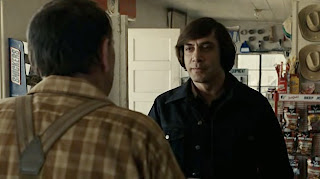
BEST OF THE DECADE - #3: No Country For Old Men

No Country For Old Men (2007): Written and directed by Joel and Ethan Coen, based on the novel by Cormac McCarthy. Starring: Tommy Lee Jones, Javier Bardem, Josh Brolin. Rated R (strong graphic violence and some language). Running time: 122 minutes.

**NOTE: This review freely discusses the final scenes of the film, so be forewarned of spoilers.

Strange, that after three viewings, I’m still at a loss to identify what exactly No Country For Old Men is. The main storyline featuring Llewelyn Moss’s (Josh Brolin) discovery of $2 million in drug money and killer Anton Chirgurh’s (Javier Bardem) subsequent pursuit of him are the makings of a fine crime thriller. Sheriff Ed Tom Bell’s (Tommy Lee Jones) investigation adds an element of a police procedural to film, but after much of the main action concludes, the film curiously stays with him for an additional 20 minutes. If you ask the Coen Brothers, they’d call the film a comedy, but perhaps it’s more of an absurdist drama, a comment on the randomness of crime and violence. Its lack of a clear identity is one of its mysteries, and in attempting to identity the parts of No Country, one begins to get at its intent.

The film is set near the Texas/Mexico border in 1980, when drug-related violence was at a peak from illegal trades across the border. However, if not for specific time markers, we might think the film is set in a post-apocalyptic world. In one scene, as Moss runs on foot from a group of Mexican drug dealers, a bolt of lightning splits the sky. Another scene sets a gritty standoff in an eerily quiet street that only offers parked cars as cover. Jones’s aged Sheriff Bell explains in his opening monologue, he doesn’t know what time make of this new world’s crime. The darkness and brutality of the violence he’s faced with has no logic or reasoning, and it appears to him that the world around him is becoming just as bleak.

Anton Chigurh presents himself as a product of this environment, and his identity is a mystery in itself. Bell thinks he’s a ghost. Or is he an incarnation of Death? Both theories are refuted in one scene that shows him bandaging a gunshot wound, revealing him to be very much human. Still, Chigurh views himself as more of a force than a man. For him, the murders he commits are not his choice, and he decides people’s fates by a coin toss. “I got here the same way the coin did,” he says. He is simply facilitating our eventual deaths. There is no systematic technique to his killings – he is not a serial killer in this sense – but he does retain a consistent tone and attitude. In several scenes, he speaks calmly to his potential victims, telling one man to “Hold still” and inquiring into another man’s family life. In others, he acts quickly and efficiently, and the Coen Brothers do not cut away from these killings. In this sense, the camera is as unflinching as Chigurh is. If the violence feels gratuitous, Sheriff Bell shares your view.

As the characters move through this bleak world, the pace remains methodical, and there is barely any musical score, with several sequences presnted in near silence. As a result, these scenes take on a chilling, sober air, and we find ourselves drawn to them with an almost animalistic fascination as Llewelyn fights for survival. The dialogue is minimalistic, and though the Coen Brothers claim to have simply opened up Cormac McCarthy’s novel and transcribed the dialogue, the pacing and delivery of it are decidedly Coen-esque. Watch how Javier Bardem takes the time to chew cashews in between lines of the first coin toss scene and raises his eyebrows to emphasize a point just before leaving. Later, a frank exchange between Llewellyn, dressed only a hospital gown, and a salesman elicits a laugh when the man states that, “It’s unusual” for a customer to come in without clothes on. These touches of humor and strangeness seep into the film without ever disturbing the film’s solemnity.

One of the main sources of mystery surrounding the film comes from what at first appears to be an extended epilogue after the main action has ended. The focus is redirected to Bell as he struggles to understand the world he is now a part of, ultimately conceding that he has neither the strength nor the will to actively fight back. A conversation with his uncle, a retired sheriff, convinces him this resignation is for the best; the evil forces in the world are too much for him. The scene that follows presents the film’s only glimmer of hope, a meeting between Llewelyn’s wife, Carla Jean (Kelly Macdonald) and Chigurh, who she finds in her home. When asked to call Chigurh’s coin toss, she refuses, stating that the coin has no say. Her resistance to Chigurh’s game expresses a belief that the world, Chigurh included, does not need to be the way it is. The scene cuts before we see his actions, but he checks the soles of his shoes in the next shot, and we know from a previous scene where he lifts his feet from a spreading pool of blood that he has killed her. The film returns to Bell for the final scene, ending with his recounts of two dreams featuring his father. He explains how his father never saw these times, and perhaps he wishes he hadn’t either. Reinforcing the theme of changing times is the sound of a clock in the background that is heard after the cut to black and into the credits. In the dream, Bell’s father is “going on ahead” to build a fire in the dark, perhaps a sanctuary in the afterlife of some sort, and in time, Bell will be joining him.

No Country For Old Men is a virtually perfectly edited film; nothing unnecessary is said or shown. It showcases the peak of the Coens’ craftsmanship, every shot a beautiful visualization of McCarthy’s bleak world, every character, no matter how minor, a fleshed out individual. It is a film that exists outside strict genre identity, delivering a potent and uncompromising take on a brutal and violent country.

- Steve Avigliano, 2/10/10