Showing posts with label 3D. Show all posts

Monday, January 2, 2012

REVIEW: The Adventures of Tintin

The Adventures of Tintin (2011): Dir. Steven Spielberg. Written by: Steven Moffat and Edgar Wright & Joe Cornish, based on the comics by Hergé. Starring: Jamie Bell, Andy Serkis, Daniel Craig, Simon Pegg and Nick Frost. Rated PG (Swashbuckling and a boozing sea captain). Running time: 107 minutes.

2 stars (out of four)

Steven Spielberg built his career on turning his boyhood fantasies into Hollywood blockbusters. When you watch the most imaginative of his big-budget adventures – Raiders of the Lost Ark, Jurassic Park, Minority Report – you get the sense that a young Spielberg might have made the same movie had he had the technical skills and financing at his disposal the adult Spielberg does. The same is true of his buddy, George Lucas. At some gut level just they knew the stories in their heads, full of dashing heroes and journeys to exotic worlds, would make fine crowd-pleasers.

So the pairing of Mr. Spielberg and Peter Jackson, that Kiwi who had the crazy idea he could turn The Lord of the Rings into a trilogy of hit movies, makes sense. They share a mutual love of the French comic book series, The Adventures of Tintin, and set out to recreate on the big screen the rich, vibrant world they had already known for years. Mr. Spielberg would direct the first and, should it be a hit, Mr. Jackson would helm the second installment.

The Adventures of Tintin, which was filmed with motion-capture animation and released in 3D, seems to have all the right ingredients – a boy and his dog discover a clue to a mystery and embark on a globetrotting trek to solve it – but the movie fails to capture the magic that seems so effortless in other Spielberg films.

The boy is Tintin (Jamie Bell) and the clue is a cryptic piece of parchment concealed inside a model ship he bought secondhand from a street vendor. He might have known the purchase would spark trouble after a man named Ivan Sakharine (Daniel Craig) tries to buy the ship off Tintin. Sakharine needs only to utter a few words in Mr. Craig’s ominous, British drawl for us to know he’s the Bad Guy and Tintin wisely keeps the ship for himself, sensing an opportunity for adventure.

And how right he is! Before he knows it, Sakharine kidnaps him and he is onboard a real ship where he meets a drunken sea captain, Haddock (Andy Serkis). Haddock and Sakharine have a longstanding feud that is apparently news to Haddock; their ancestors were rival pirates and Sakharine’s relative cursed Haddock’s after the latter robbed him of his gold. Or something.

The plot details in these sorts of movies are more-or-less irrelevant as long the story takes our heroes from Land A to Land B and back again, which The Adventures of Tintin does. As it turns out, the parchment features as series of cryptic symbols along the bottom that can only be understood when read with two other notes, also hidden inside model ships. So we begin in Europe, where the first two ships are, then hop over to Morocco where the third is. The intervening trip involves travel by boat, plane and motorcycle and there is no shortage of dazzling animated action sequences.

So where does Tintin go wrong? To be honest, I’m at a bit of a loss to say but let’s start with the animation, which, on a surface level, is stunning. How an animator is able to recreate the look of a rainy street or the sun glistening off ocean waves in such a way that looks somehow better than the real thing, I’ll never know. The movie also looks great in 3D; the animation is crisp and sharp, and the added effect of the 3D is seamless.

But the inhabitants of this digital world have an odd quality about them. Because the actual physical performances of actors are being used through motion-capture, the characters of Tintin move like real people. Yet they remain cartoonish; they have big heads, exaggerated features and curvy, rubbery bodies. The strangeness of this look is especially noticeable in the film’s comedy, which is mostly broad and slapstick. The antics of a pair of bumbling coppers (Simon Pegg and Nick Frost) are limited by the use of real actors. They appear to be cartoon characters but because their bodies have none of the elasticity of say, Wild E. Coyote when he steps off a cliff, their movements appear curiously stiff.

This creepy middle ground between animated people and the real thing kept the movie at a distance for me. A scene such as a motorcycle chase through a Moroccan town, shown in one long take, is breathtaking but also not as exciting as it should be. There is too much of a sense that these are pixels being cleverly manipulated to look like buildings, boats and boy who ducks and dives between them. The movie is visually impressive but only superficially so.

The failings of The Adventures of Tintin are not so great as to shake my faith in Mr. Spielberg’s talent, but the movie does make me realize how much I take for granted the action movies of his that do work. My inner child is always eager to escape into a movie and who knows, maybe Tintin’s next adventure will allow him to do so.

- Steve Avigliano, 01/02/12

Thursday, December 1, 2011

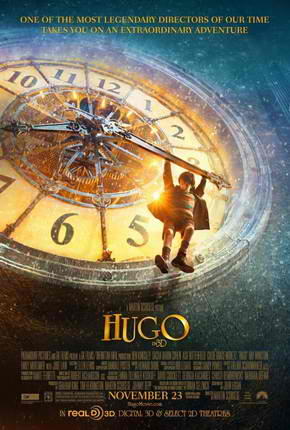
REVIEW: Hugo

Hugo (2011): Dir. Martin Scorsese. Written by: John Logan. Based on The Invention of Hugo Cabret by Brian Selznick. Starring: Asa Butterfield, Ben Kingsley, Sacha Baron Cohen, Chloë Grace Moretz, Ray Winstone, Jude Law, Emily Mortimer, Christopher Lee, Richard Griffiths and Frances de la Tour. Rated PG. Running time: 127 minutes.

3 stars (out of four)

Director Martin Scorsese’s first foray into 3D, Hugo, appears on first glance to be a Spielbergian piece of family entertainment about an orphaned boy’s adventures in a 1930s Paris train station. The film, adapted from Brain Selznick’s award-winning book, The Invention of Hugo Cabret, is curiously both more than that first impression suggests and somehow a little less.

We first see Hugo Cabret (Asa Butterfield) as he peers out at the station’s busy lobby from behind the face of a large clock. Through flashbacks we learn he is the son of a watchmaker (Jude Law in a brief cameo) who taught his son all about the inner workings of timepieces. Prior to his father’s death, the two were repairing an automaton, a small robotic man of extraordinarily intricate design Hugo’s father picked up at a museum. The machine is missing a crucial piece – a heart-shaped key – that Hugo’s father has drawn for reference in a small notebook Hugo later inherits.

Hugo then comes under the dubious care of his uncle (Ray Winstone in an even briefer cameo), a drunk who repairs the train station’s clocks and disappears almost as soon as he adopts the poor boy. This leaves Hugo to roam the station alone, dodging the watchful eyes of Inspector Gustav (Sacha Baron Cohen), who has made it his purpose in life to catch stray orphans in the station and ship them off to some nondescript Dickensian nightmare or another.

Inspector Gustav is unaware, however, of the many ventilator ducts and behind-the-wall passageways Hugo calls home. From these hidden vantage points, Hugo safely observes the station’s population below him. (Richard Griffiths, Christopher Lee, Emily Mortimer and Frances de la Tour each have a few scenes apiece as various proprietors in the station.) But it is Ben Kingsley as the owner of a toy shop who Hugo is most interested in and vice versa.

Hugo has been stealing toys from the shop not to play with but to disassemble for parts. When Papa Georgie, as his goddaughter Isabelle (Chloë Grace Moretz) calls him, catches Hugo red-handed, a mysterious and pensive look crosses the old man’s face at the sight of Hugo’s notebook. Does this look signify some mystery for Hugo and new friend Isabelle to solve? Some past secret from Hugo’s or Papa George’s life? A hint at the cause of Hugo’s father’s untimely death?

The mystery, without giving away too much, turns out to be a lesson in film history, which, I must say, I wasn’t expecting. That is not to say the film loses any of its charm as Martin Scorsese pays tribute to the silent era of cinema – these scenes are as visually inventive and whimsical as anything else in the film – but I wonder: To what degree will the film’s younger audience appreciate this sudden turn? Hugo is a bit overlong, especially considering that it is being marketed as a family adventure, and by its second half its gradual pacing begins to feel like the film is dragging its heels.

This is no fault of Hugo’s young stars though, who carry the film nicely. Asa Butterfield is a strong and amiable lead and Chloë Grace Moretz shows her range as the plucky bookworm. The adults stand by to support them and Sacha Baron Cohen’s comic timing looks to have cross-generational appeal (to both older and younger audiences than his typically raunchy, scatological characters attract).

The film’s 3D gives a number of shots an added layer of wonder but Hugo’s most visually appealing qualities – its muted colors, its meticulous set design – do not need the effect; they are enchanting enough on their own. So while Martin Scorsese’s first use of 3D is well executed, I cannot say it was worth adding $5 to the ticket price. This continues to be 3D’s biggest drawback. I’m willing to remain open to each filmmaker’s take on the technology but not at these prices.

Mr. Scorsese looks to be on-board with it though. By evoking the dazzling imagination and visuals of cinema’s earliest works, he argues that the movies have always been about the spectacle of technological innovation. I wonder if the film might have been more effective had it gone even bigger – more magic! more mystery! – and if it had more of its director’s characteristic vigor and energy. In its quiet way though, the film ever so gently reminds us of the movies’ ability to inspire wonder and to invent.

- Steve Avigliano, 12/1/11

Wednesday, November 9, 2011

REVIEW: A Very Harold & Kumar 3D Christmas

A Very Harold & Kumar 3D Christmas (2011): Dir. Todd Strauss-Schulson. Written by: Jon Hurwitz and Hayden Schlossberg. Starring: John Cho, Kal Penn, Neil Patrick Harris, Thomas Lennon, Amir Blumenfield and Danny Trejo. Rated R (An endless night of debauchery including drugs, cursing, sex and tasteless humor). Running time: 89 minutes.

3 stars (out of four)

In A Very Harold & Kumar 3D Christmas, Santa smokes from a bong, a claymation penis leaps off the screen and an infant tries every party drug your D.A.R.E. instructor warned you about, mercifully not all in the same scene. These are hardly the funniest moments in the movie nor are they even the most ridiculous, which should say something about the spectrum of insanity on display here. AVH&K3DC is ruder, cruder and in general escalates the crazy compared to the previous two installments of the stoner buddy comedy franchise. To say that the film was made to seen in a specific state of mind goes without saying, but the film, in its giddy willingness to do anything and everything for a laugh, gives off an intoxicating effect all its own. Just watching the movie gives you a sort of contact high.

Of course, none of the film’s THC-induced antics would work were they not funny. And AVH&K3DC is very funny. Its breakneck pace is a major asset to its success because no gag runs the risk of overstaying its welcome. Didn’t think that perverse twist on a classic scene from A Christmas Story was all that funny? Maybe you thought that bit about nuns crossed the line? Not to worry. That was already two jokes ago and the movie is onto something new. And unlike a lot of comedies that offer equivalent jpm (jokes per minute), the hit-to-miss ratio here is high in favor of laughter.

The manic pacing and style of the movie works also because the plot is pushed so far into the realm of the absurd that there is no chance anything will be taken too seriously. Writers Jon Hurwitz and Hayden Schlossberg (who have written all three films) have wisely upped the stakes with each passing movie (from a late-night trip to White Castle to a brush-up with the government in Guantanamo Bay to this) and have successfully kept the franchise fresh rather than retreading familiar material.

What’s truly astonishing though is how our hazy heroes, Harold (John Cho) and Kumar (Kal Penn), remain grounded in reality even as the world around them careens out of control. There are some genuinely touching moments between the two (usually offset by a gross-out gag to avoid sentimentality) and the strength of their friendship lies at the heart of these films.

As is typical for a Harold & Kumar film, there is also a dash of social commentary, though this outing’s racial-political consciousness is far more muted than before. The movie pokes fun at racial stereotypes and the casual prejudices people harbor in modern-day America but these concerns do not pervade the film’s humor, which mostly prefers to indulge in the raunchy and juvenile. Of the film’s women I will not elaborate other than to say that they are merely marginalized rather than degraded; take that for what it’s worth. AVH&K3DC is smarter than your average male-dominated raunchfest but isn’t trying to reinvent the wheel; it’s still very much in love with its lowbrow self.

The use of 3D is a silly gimmick but in a way (and bear with me for a moment here) is kind of groundbreaking. The effect, often toted as an immersive technology is self-consciously acknowledged in both the dialogue and its actual execution. In one scene, for example, a traffic cone is hurled toward us only to crash against the camera and crack the lens. The movie calls attention to the artifice of 3D and then uses that as a tool to further its self-referential nature.

The Harold & Kumar franchise continues to reshape itself in new and unexpected ways and if there is a fourth film (Neil Patrick Harris, again playing a hilarious Bizarro version of himself, flat out announces in this film that there will be a fourth) there may need to be a more substantial story, but this episode should not disappoint fans of the previous two. It is a wild and reckless blur of a movie that defies my better judgment and admittedly made me a laugh a whole lot. It understands the importance of brevity, doesn’t try too hard and is a wholly satisfying, smoky affair.

- Steve Avigliano, 11/9/11

Thursday, July 1, 2010

Do We Need 3D?

I don’t fully understand the technical reasons why watching a movie in 3D is worse than a normal viewing, but I do know these things: 1) The picture is dimmer in a 3D movie. 2) The 3D effect is distracting. 3) It adds a surcharge to an already expensive ticket.

There are technical reasons why 3D gives us a dimmer picture, but you don’t need to be an expert on film projection to notice the difference. Should you see Toy Story 3 in 3D, consider for a moment past Pixar movies. The studio’s films have always been vibrant and colorful and yet here (and when Up came out in 3D last year), everything is a shade too dim, as though the entire film were taking place at dusk. Why is this? Something about the 3D process makes the image dimmer, but those glasses don’t make it any better. Granted, they’re a marked improvement from those red/blue glasses that used to be the standard, but they’re still a discomfort. And if you already wear glasses, they’re even worse, having to awkwardly place them over your prescription lenses.

But this gets more into my second problem with 3D – that it’s a distraction. When Avatar came out, the buzzword everybody used was “immersive.” James Cameron’s innovations in 3D technology were supposed to pull the viewer in and make them a part of the experience. For many, the effect worked. For me, it was frequently distracting. Yes, those sweeping shots of oceans and flying mountains looked pretty spectacular in 3D (though I suspect they’d have been just as memorable without it), but what about the dramatic scenes in between the sweeping effects shots and action sequences? Did you notice the way the image blurs a little when two people are just sitting and talking to each other, or walking? Some call the effect “ghosting” and it was all over the place when I saw Avatar. The 3D blends nicely in action scenes, but for those quieter moments, it became very noticeable that I was watching a 3D movie, pulling me out of the experience rather than into it.

3D is being touted as the next great innovation in movies, as if 2D movies are suddenly inferior and outdated. Even using the term 2D is a misnomer. Were you ever unsatisfied with how “flat” movies used to be? No, of course not. That’s because since birth, our eyes and brain have worked together to interpret pictures and film as representations of depth and movement. Adding the artificial third dimension only calls attention to the fact that we’re watching a movie.

And then there’s the price. We’re paying extra money for an inferior product. I’m dazzled enough by Pixar’s animation, or the latest CG effects, why do we need 3D? The simple answer is that we don’t. Studios like it because they can make money off it, and they are. Avatar is the highest-grossing movie of all-time, largely thanks to the 3D surcharges. Then there’s the IMAX surcharge that, in an AMC theater, charges you for putting a faux-IMAX screen in front of the regular screen.

These scams will exist as long as people are paying for them. Christopher Nolan spoke out recently against 3D in response to questions about how the third Batman will be filmed. He explains that the choice is not up to him. Audience members speak through ticket sales and studios listen by looking at box office receipts.

So ask yourself: Do you need to see Toy Story 3 in 3D? Or Harry Potter? Or (God help us) the new Jackass movie? You can voice your opinion one way or the other with a ticket purchase.

Further reading: Roger Ebert’s “Why I Hate 3D (And You Should Too)”

- Steve Avigliano, 7/01/10

Friday, June 18, 2010

REVIEW: Toy Story 3

Toy Story 3 (2010): Dir. Lee Unkrich. Written by Michael Arndt. Featuring the voices of Tom Hanks, Tim Allen, Joan Cusack, Ned Beatty, Don Rickles, and Michael Keaton. Rated G. Running time: 103 minutes.

3 ½ stars (out of four)

We all outgrow our toys eventually, but the wonderful thing about great films, and this is especially true of great children’s films, is that they grow with us. I was 6 years old when the first Toy Story came out and 10 when I saw the second in theaters, and in revisiting the films I found they’ve not only lost none of their charm, but in fact resonate with me more than ever. Toy Story 3, arriving nearly 11 years after the first sequel, is the most sophisticated of the series, in both its animation and its message, ending the series on a poignant and wholly satisfying note.

Toy Story 3 finds Woody and Co. in a dark place – and not just in the literal sense of their placement in the forgotten toy box. Toy population in Andy’s room has shrunk after years of yard sales and garbage days, leaving only a handful of sentimental favorites left – both an economical decision by the filmmakers to not overcrowd the film with unnecessary side characters and also a heartbreaking reminder of the toys’ impermanence. As Andy packs for college, he must decide whether to hold on to these mementos of his childhood, donate them to a local daycare or forsake them to the dump. Andy, the sentimentalist he is, elects to store them in the attic with the exception of Woody, who gets an honored placement in the college box. When Andy’s mother mistakenly brings them out to the curb – a reasonable misunderstanding considering Andy packs them in a black garbage bag – the toys decide they’d rather be donated than trashed and they hitch a ride to the Sunnyside Daycare Center.

Sunnyside, in typical Pixar inventiveness, is an exciting new world filled with vibrant colors and the promise of being played with by children all day long. It seems to them Toy Heaven, an eternal life of playtime. When children grow up at Sunnyside, explains a stuffed bear and leader of Sunnyside named Lots-O’-Huggin’-Bear (Lotso for short), a new generation of kids replaces them. You’ll never need to feel the heartbreak of your owner outgrowing you because there will always be another child ready to play with you.

Woody, who has accompanied his friends this far, refuses the invitation to this seeming utopia and, in spite of his friends’ behest, embarks on a journey back to Andy’s. His failed escape, another of the thrilling toy’s-eye-view action sequences we’ve come to expect from the series, ends when a little girl, Bonnie, snatches him off the ground and brings him home. Bonnie’s room proves to be another temptation for Woody, a place where he can get all the loving, one-on-one playtime he no longer receives from Andy.

Woody’s dilemma is rendered temporarily moot, however, when he learns from Chuckles, a less-than-cheerful clown and Sunnyside veteran, that Lotso is in fact running a totalitarian regime under the guise of a toy’s paradise. The flashback sequence detailing Lotso’s past and the subsequent breakout plan that Woody hatches have more excitement than most contemporary crime films and serve as a reminder of why Pixar is still tops in animation. The studio crafts complex stories that don’t insult a child’s (or an adult’s for that matter) intelligence, and thrives on visual and narrative inventiveness.

And this is only the main narrative thread. The film is peppered with clever details and inspired tangents that come together nicely by the climax. Watch how the film shows Mrs. Potato’s ability to see in two places at once, after she leaves her detachable left eye in Andy’s room, or how the “men” of the Sunnyside toys gamble in their spare time. There’s also an ingenious subplot involving Barbie’s seduction by fashion of a Ken doll, a comedic highpoint of the film. There are a few recycled ideas – as an antagonist, Lotso recalls Toy Story 2’s Prospector in both his voice and cane-assisted walk, and when Buzz is set to “demo mode” it's a bit of a retread of his encounter with a fresh-off-the-shelves Lightyear model from Al’s Toy Barn – but even these familiar elements improve upon the original ideas enough that they remain fresh.

Toy Story 3 is every bit as imaginative and funny as the first two installments (without getting too joke-y, something the previous were even at their best), but has an emotional core that elevates and enriches its predecessors. The film, and the series on a whole, teaches acceptance of life’s changes and shows how this leap of faith is often rewarded with joys previously unknown. In the first film, Woody doesn’t want to accept that Andy might have found a new favorite toy in Buzz, but he ultimately forges an indelible friendship with the space ranger. In 2, Woody and the gang begin to accept that their owner will one day grow up, an acceptance that becomes fully realized in this film. This theme is echoed throughout the film and we see how Lotso’s reluctance to accept his own abandonment has corroded him.

The opening scene of Toy Story 3 recalls that of the first film, with Andy as a child acting out an imagined battle between Woody and Mr. Potato Head. But while the first film allowed us to observe a child playing with his toys, this one invites us inside his imagination and we see the action play out with all the dazzle Pixar’s animation team can afford. Andy’s experience is not one that we watch from a distance, but is in fact representative of what we all go through in our adolescence… and beyond.

The final shot, of white clouds on a blue sky, is a direct reference to the first image of Andy’s wallpaper at the start Toy Story. As Andy leaves his room and his toys for college, we realize that he is not abandoning that old room, but rather moving on to a larger arena, that of the real world. The room is a training ground, preparing Andy for life until he is ready to go out on his own. The films, now a completed story, offer us a similar training, showing the value in letting go and moving on to better things. And that’s something I’ll never get too old for.

** NOTE: I saw this film in Disney Digital 3D for an extra $3 and it added little to the film experience for me except a dimmer picture. More on 3D next week though.

- Steve Avigliano, 6/18/10

Sunday, December 27, 2009

REVIEW: Avatar

Avatar (2009): Written and Directed by James Cameron. Starring: Sam Worthington, Zoe Saldaña, Sigourney Weaver, Stephen Lang, Joel David Moore, Michelle Rodriguez. Rated PG-13 (intense epic battle sequences and warfare, sensuality and language). Running time: 161 minutes.

3 stars (out of four)

** Note: I saw the film in its IMAX 3D version at an AMC theater.

James Cameron has been a pioneer of computer effects since 1989’s The Abyss and each of his successive films, including Terminator 2 and Titanic, has brought the technology to new heights. Avatar is the next great leap forward, featuring the most sophisticated use of computer animation and motion-capture technology yet, the result of a labor of love that dates back to 1994. Unlike previous Cameron outings, however, the movie lacks a strong script. The consistently impressive visuals are not quite enough to keep the story from becoming underwhelming in its familiarity.

In Avatar’s distant future, the people of Earth have found their way to the forest moon of Pandora, where a mining operation is underway in pursuit of the unimaginatively titled mineral, unobtanium. Dr. Grace Augustine, played by Cameron-vet Sigourney Weaver, leads a research team to explore the world and communicate with the natives, big blue humanoids called the Na’vi. Her team remotely controls genetically created Na’vi imitations called Avatars to establish better relations with the alien race, but their peaceful efforts are continuously hindered by a military presence led by Colonel Quaritch (Stephen Lang). The Colonel’s brutal pep talk to his Marines consists of reminding them of their perpetual risk of death on Pandora. Caught between the two is disabled Marine, Jake Sully (Sam Worthington), who flies to Pandora after his deceased brother leaves a vacancy in the Avatar program. Sully’s recruitment is twofold, using his Avatar to learn about Na’vi culture, while also acquiring information regarding the location of unobtanium fields for Quaritch. It’s not long before Sully falls for Na’vi life and a Na’vi female (Zoe Saldaña), and suffers the moral conflict that comes with double agency.

The film’s plot, boiled down to its essentials is a familiar one, placing the emotional conflict of Dances With Wolves into a setting not unlike Return of the Jedi’s Endor, while preaching an environmental message much like that of Fern Gully. Though Cameron’s visual imagination in creating the alien world keeps the film from feeling stale, his script too often uses these borrowed elements as a crutch. One gets the impression that Cameron focused all his energy on the look of Pandora, leaving the story an assortment of used parts. The film’s most narratively interesting moments come in its midsection as Jake Sully struggles with issues of identity switching between his human body and Avatar counterpart. Worthington, who was a lifeless statue earlier this year in Terminator: Salvation, brings a compelling everyman quality to Sully in a heartfelt performance. Once Sully’s assimilation into the Na’vi tribe is complete, however, the script shifts onto the usual track, ending with a climatic battle against the humans for Pandora.

Aside from Sully, all of Avatar’s characters are archetypes except perhaps for Dr. Augustine, but Sigourney Weaver never manages to fully sell her character’s tougher side. Michelle Rodriguez appears as a Marine pilot, a strangely underdeveloped character considering the pivotal role she plays near the film’s end. Though the film runs long at 161 minutes, the narrative moves quickly, relying heavily on montages and condensed exposition. Cameron’s original cut of the film is said to have been well over 3 hours, and one wonders if the cut scenes would have strengthened its characters and pacing. While an extended running time might help, it would not rectify all of Avatar’s problems. Much of the film’s dialogue is clichéd and the ending features a deus ex machina bigger (in more ways than one) than Return of the King’s eagle saviors.

All of these concerns become moot, however, in Avatar’s visual presentation. More than once I was wowed by breathtaking panoramic shots, and the motion capture animation is thoroughly convincing at all times. Cameron crafts moments of sheer awe without ever flaunting his technology simply because he has the capability to. Like the Star Wars films, the visual effects stem from endless creativity in the shaping of a colorful, fully realized world. Avatar’s divergences into the life and culture of Pandora make up its most thrilling moments. Cameron provides several memorable action sequences, not the least of which is the final battle – both absorbing and gleefully over-the-top. Where other action films get queasy in their kinetic editing, Avatar features crisp cuts and remembers to engage the audience in the fun. That this is Cameron’s first non-documentary film since 1997 is a shame considering the multitude of disappointing action flicks that have passed through theaters in the last twelve years.

But the delay was not in vein, and Cameron has supposedly developed new types of digital cameras and 3D technology in preparation for Avatar’s release. As far as the 3D presentation of Avatar goes, I’m still not convinced that the trend is much more than a gimmick. While the gimmick is expertly used here, the uncomfortable glasses and the frequent jerkiness of the picture onscreen – most noticeable in dialogue scenes – remain distracting. The 3D experience attempts to immerse the audience in the action, but I found the extra dimension kept me at a distance from the film. I’m impressed enough by computer animation in two dimensions and, for me, using my two eyes alone remains the definitive way to watch a movie.

Nevertheless, Avatar is the result of supreme craftsmanship and, at the very least, will be remembered for its innovative and seamless use of computer animation. In this regard, Avatar earns placement next to other effects-laden epic films such as Star Wars and Lord of the Rings, but the film lacks the characters and story that make those films timeless. Then again, maybe Avatar will prove itself to be a worthy first installment of a longer franchise. Only time and another $300 million dollars will tell.

- Steve Avigliano, 12/27/09