Showing posts with label Jude Law. Show all posts

Thursday, December 1, 2011

REVIEW: Hugo

Hugo (2011): Dir. Martin Scorsese. Written by: John Logan. Based on The Invention of Hugo Cabret by Brian Selznick. Starring: Asa Butterfield, Ben Kingsley, Sacha Baron Cohen, Chloë Grace Moretz, Ray Winstone, Jude Law, Emily Mortimer, Christopher Lee, Richard Griffiths and Frances de la Tour. Rated PG. Running time: 127 minutes.

3 stars (out of four)
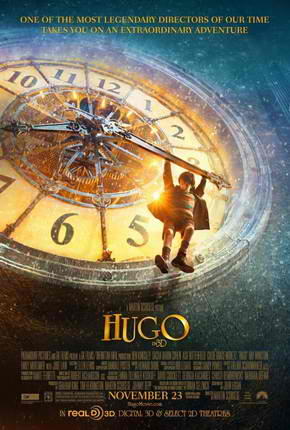
Director Martin Scorsese’s first foray into 3D, Hugo, appears on first glance to be a Spielbergian piece of family entertainment about an orphaned boy’s adventures in a 1930s Paris train station. The film, adapted from Brain Selznick’s award-winning book, The Invention of Hugo Cabret, is curiously both more than that first impression suggests and somehow a little less.

We first see Hugo Cabret (Asa Butterfield) as he peers out at the station’s busy lobby from behind the face of a large clock. Through flashbacks we learn he is the son of a watchmaker (Jude Law in a brief cameo) who taught his son all about the inner workings of timepieces. Prior to his father’s death, the two were repairing an automaton, a small robotic man of extraordinarily intricate design Hugo’s father picked up at a museum. The machine is missing a crucial piece – a heart-shaped key – that Hugo’s father has drawn for reference in a small notebook Hugo later inherits.

Hugo then comes under the dubious care of his uncle (Ray Winstone in an even briefer cameo), a drunk who repairs the train station’s clocks and disappears almost as soon as he adopts the poor boy. This leaves Hugo to roam the station alone, dodging the watchful eyes of Inspector Gustav (Sacha Baron Cohen), who has made it his purpose in life to catch stray orphans in the station and ship them off to some nondescript Dickensian nightmare or another.

Inspector Gustav is unaware, however, of the many ventilator ducts and behind-the-wall passageways Hugo calls home. From these hidden vantage points, Hugo safely observes the station’s population below him. (Richard Griffiths, Christopher Lee, Emily Mortimer and Frances de la Tour each have a few scenes apiece as various proprietors in the station.) But it is Ben Kingsley as the owner of a toy shop who Hugo is most interested in and vice versa.

Hugo has been stealing toys from the shop not to play with but to disassemble for parts. When Papa Georgie, as his goddaughter Isabelle (Chloë Grace Moretz) calls him, catches Hugo red-handed, a mysterious and pensive look crosses the old man’s face at the sight of Hugo’s notebook. Does this look signify some mystery for Hugo and new friend Isabelle to solve? Some past secret from Hugo’s or Papa George’s life? A hint at the cause of Hugo’s father’s untimely death?

The mystery, without giving away too much, turns out to be a lesson in film history, which, I must say, I wasn’t expecting. That is not to say the film loses any of its charm as Martin Scorsese pays tribute to the silent era of cinema – these scenes are as visually inventive and whimsical as anything else in the film – but I wonder: To what degree will the film’s younger audience appreciate this sudden turn? Hugo is a bit overlong, especially considering that it is being marketed as a family adventure, and by its second half its gradual pacing begins to feel like the film is dragging its heels.

This is no fault of Hugo’s young stars though, who carry the film nicely. Asa Butterfield is a strong and amiable lead and Chloë Grace Moretz shows her range as the plucky bookworm. The adults stand by to support them and Sacha Baron Cohen’s comic timing looks to have cross-generational appeal (to both older and younger audiences than his typically raunchy, scatological characters attract).

The film’s 3D gives a number of shots an added layer of wonder but Hugo’s most visually appealing qualities – its muted colors, its meticulous set design – do not need the effect; they are enchanting enough on their own. So while Martin Scorsese’s first use of 3D is well executed, I cannot say it was worth adding $5 to the ticket price. This continues to be 3D’s biggest drawback. I’m willing to remain open to each filmmaker’s take on the technology but not at these prices.

Mr. Scorsese looks to be on-board with it though. By evoking the dazzling imagination and visuals of cinema’s earliest works, he argues that the movies have always been about the spectacle of technological innovation. I wonder if the film might have been more effective had it gone even bigger – more magic! more mystery! – and if it had more of its director’s characteristic vigor and energy. In its quiet way though, the film ever so gently reminds us of the movies’ ability to inspire wonder and to invent.

- Steve Avigliano, 12/1/11

Tuesday, September 13, 2011

REVIEW: Contagion

Contagion (2011): Dir. Steven Soderbergh. Written by: Scott Z. Burns. Starring: Marion Cotillard, Matt Damon, Laurence Fishburne, Jude Law, Gwyneth Paltrow, Kate Winslet. Rated PG-13 (Language and gruesome symptoms). Running time: 106 minutes.

3 stars (out of four)

During a quiet scene in Contagion, the new film from director Steven Soderbergh, I became acutely aware of every sound in the theater – every crinkle of a wrapper, every clearing of a throat – and realized the film was doing what it was intended to do.

Early on in Contagion there is a reference to Jaws that reveals the film’s aim. Similar to how that Spielberg classic played on our fear of the open ocean and made audiences think twice before the next time they went for a dip, Contagion takes a common fear – a worldwide virus outbreak – and crafts an effective thriller around it. We learn in the film that we touch our faces hundreds of times per day, (a point reinforced by frequent close-ups of hands), an unconscious habit that allows for the rapid spread of disease. With that information planted in our minds, each cough and sniffle in the film (deliberately foregrounded in the audio mix) become Contagion’s fin in the water – a sign of impending danger.

The film builds its queasy energy by assembling several storylines with characters that are connected by the mysterious disease. There is the American (Gwyneth Paltrow) whose business trip to Hong Kong may be responsible for the initial spread of the disease. Her husband (Matt Damon) and daughter (Anna Jacoby-Heron) provide the emotional arc of the film as they grapple with day-to-day life while the virus takes hold of the country.

On the bureaucratic end of things are Dr. Cheever (Laurence Fishburne) and his protégé Dr. Mears (Kate Winslet) of the Center for Disease Control and Prevention (CDC) who investigate the disease in pursuit of a cure. Assisting in that goal are researchers Ian Sussman (Elliott Gould) and Dr. Hextall (Jennifer Ehle) as well as French correspondent Dr. Orantes (Marion Cotillard) whose investigation of the outbreak’s source in Hong Kong takes an unexpected turn.

Meanwhile, a vicious blogger named Alan Krumwiede (Jude Law) scrutinizes the CDC’s every move and makes allegations of a partnership between the government and pharmaceutical companies. He is a political revolutionary of the modern age whose shocking online posts bring new meaning to the phrase ‘viral videos.’

Krumwiede is one of the film’s many insistent (bordering on incessant) reminders that the film takes place in the present day. Information is obtained and spread through video surveillance, texting, Twitter and other technological advancements familiar to most Millennials. These contemporary details are pervasive to the point of being overwhelming, though perhaps that’s the point. Much of the film’s dialogue blows by in a flurry of acronyms and multisyllabic mouthfuls, a fair dramatization of information overload in the Internet Age.

Soderbergh handles this material well, though. His frenetic style makes sense of the chaos unfurling onscreen and pulls the film’s many characters together into a cogent whole. He balances tense scenes of frayed nerves and frantic phone calls with more sober moments of investigative reporting that plunge into the murky realm of geopolitics without getting didactic.

Emphasis on international affairs does lead to an inherent lack in human empathy. The film is more interested in presenting the inner workings (and subsequent failings) of government agencies than telling a story about individuals. Soderbergh explores the ways in which these agencies communicate with one another to find a balance between law and moral order when catastrophe strikes. Contagion is critical of the layers of red tape that prevent decisive action but never villainizes any of its characters.

On further reflection, the earlier comparison to Jaws is not a perfect one. In 1975, that film created – or at least propagated – a fear of shark attacks. The terror lurking behind every scene of Contagion, however, does not originate with the film but rather is one that has already attained a level of omnipresence in our lives. Whether the threat of a pandemic is just media noise or indeed the fate of mankind remains to be seen. Either way, Contagion thoroughly documents that fear for future generations and offers a chilling apocalyptic tale in the meantime.

- Steve Avigliano, 9/13/11