Thursday, July 1, 2010

Do We Need 3D?

I don’t fully understand the technical reasons why watching a movie in 3D is worse than a normal viewing, but I do know these things: 1) The picture is dimmer in a 3D movie. 2) The 3D effect is distracting. 3) It adds a surcharge to an already expensive ticket.

There are technical reasons why 3D gives us a dimmer picture, but you don’t need to be an expert on film projection to notice the difference. Should you see Toy Story 3 in 3D, consider for a moment past Pixar movies. The studio’s films have always been vibrant and colorful and yet here (and when Up came out in 3D last year), everything is a shade too dim, as though the entire film were taking place at dusk. Why is this? Something about the 3D process makes the image dimmer, but those glasses don’t make it any better. Granted, they’re a marked improvement from those red/blue glasses that used to be the standard, but they’re still a discomfort. And if you already wear glasses, they’re even worse, having to awkwardly place them over your prescription lenses.

But this gets more into my second problem with 3D – that it’s a distraction. When Avatar came out, the buzzword everybody used was “immersive.” James Cameron’s innovations in 3D technology were supposed to pull the viewer in and make them a part of the experience. For many, the effect worked. For me, it was frequently distracting. Yes, those sweeping shots of oceans and flying mountains looked pretty spectacular in 3D (though I suspect they’d have been just as memorable without it), but what about the dramatic scenes in between the sweeping effects shots and action sequences? Did you notice the way the image blurs a little when two people are just sitting and talking to each other, or walking? Some call the effect “ghosting” and it was all over the place when I saw Avatar. The 3D blends nicely in action scenes, but for those quieter moments, it became very noticeable that I was watching a 3D movie, pulling me out of the experience rather than into it.

3D is being touted as the next great innovation in movies, as if 2D movies are suddenly inferior and outdated. Even using the term 2D is a misnomer. Were you ever unsatisfied with how “flat” movies used to be? No, of course not. That’s because since birth, our eyes and brain have worked together to interpret pictures and film as representations of depth and movement. Adding the artificial third dimension only calls attention to the fact that we’re watching a movie.

And then there’s the price. We’re paying extra money for an inferior product. I’m dazzled enough by Pixar’s animation, or the latest CG effects, why do we need 3D? The simple answer is that we don’t. Studios like it because they can make money off it, and they are. Avatar is the highest-grossing movie of all-time, largely thanks to the 3D surcharges. Then there’s the IMAX surcharge that, in an AMC theater, charges you for putting a faux-IMAX screen in front of the regular screen.

These scams will exist as long as people are paying for them. Christopher Nolan spoke out recently against 3D in response to questions about how the third Batman will be filmed. He explains that the choice is not up to him. Audience members speak through ticket sales and studios listen by looking at box office receipts.

So ask yourself: Do you need to see Toy Story 3 in 3D? Or Harry Potter? Or (God help us) the new Jackass movie? You can voice your opinion one way or the other with a ticket purchase.

Further reading: Roger Ebert’s “Why I Hate 3D (And You Should Too)”

- Steve Avigliano, 7/01/10

Friday, June 18, 2010

REVIEW: Toy Story 3

Toy Story 3 (2010): Dir. Lee Unkrich. Written by Michael Arndt. Featuring the voices of Tom Hanks, Tim Allen, Joan Cusack, Ned Beatty, Don Rickles, and Michael Keaton. Rated G. Running time: 103 minutes.

3 ½ stars (out of four)

We all outgrow our toys eventually, but the wonderful thing about great films, and this is especially true of great children’s films, is that they grow with us. I was 6 years old when the first Toy Story came out and 10 when I saw the second in theaters, and in revisiting the films I found they’ve not only lost none of their charm, but in fact resonate with me more than ever. Toy Story 3, arriving nearly 11 years after the first sequel, is the most sophisticated of the series, in both its animation and its message, ending the series on a poignant and wholly satisfying note.

Toy Story 3 finds Woody and Co. in a dark place – and not just in the literal sense of their placement in the forgotten toy box. Toy population in Andy’s room has shrunk after years of yard sales and garbage days, leaving only a handful of sentimental favorites left – both an economical decision by the filmmakers to not overcrowd the film with unnecessary side characters and also a heartbreaking reminder of the toys’ impermanence. As Andy packs for college, he must decide whether to hold on to these mementos of his childhood, donate them to a local daycare or forsake them to the dump. Andy, the sentimentalist he is, elects to store them in the attic with the exception of Woody, who gets an honored placement in the college box. When Andy’s mother mistakenly brings them out to the curb – a reasonable misunderstanding considering Andy packs them in a black garbage bag – the toys decide they’d rather be donated than trashed and they hitch a ride to the Sunnyside Daycare Center.

Sunnyside, in typical Pixar inventiveness, is an exciting new world filled with vibrant colors and the promise of being played with by children all day long. It seems to them Toy Heaven, an eternal life of playtime. When children grow up at Sunnyside, explains a stuffed bear and leader of Sunnyside named Lots-O’-Huggin’-Bear (Lotso for short), a new generation of kids replaces them. You’ll never need to feel the heartbreak of your owner outgrowing you because there will always be another child ready to play with you.

Woody, who has accompanied his friends this far, refuses the invitation to this seeming utopia and, in spite of his friends’ behest, embarks on a journey back to Andy’s. His failed escape, another of the thrilling toy’s-eye-view action sequences we’ve come to expect from the series, ends when a little girl, Bonnie, snatches him off the ground and brings him home. Bonnie’s room proves to be another temptation for Woody, a place where he can get all the loving, one-on-one playtime he no longer receives from Andy.

Woody’s dilemma is rendered temporarily moot, however, when he learns from Chuckles, a less-than-cheerful clown and Sunnyside veteran, that Lotso is in fact running a totalitarian regime under the guise of a toy’s paradise. The flashback sequence detailing Lotso’s past and the subsequent breakout plan that Woody hatches have more excitement than most contemporary crime films and serve as a reminder of why Pixar is still tops in animation. The studio crafts complex stories that don’t insult a child’s (or an adult’s for that matter) intelligence, and thrives on visual and narrative inventiveness.

And this is only the main narrative thread. The film is peppered with clever details and inspired tangents that come together nicely by the climax. Watch how the film shows Mrs. Potato’s ability to see in two places at once, after she leaves her detachable left eye in Andy’s room, or how the “men” of the Sunnyside toys gamble in their spare time. There’s also an ingenious subplot involving Barbie’s seduction by fashion of a Ken doll, a comedic highpoint of the film. There are a few recycled ideas – as an antagonist, Lotso recalls Toy Story 2’s Prospector in both his voice and cane-assisted walk, and when Buzz is set to “demo mode” it's a bit of a retread of his encounter with a fresh-off-the-shelves Lightyear model from Al’s Toy Barn – but even these familiar elements improve upon the original ideas enough that they remain fresh.

Toy Story 3 is every bit as imaginative and funny as the first two installments (without getting too joke-y, something the previous were even at their best), but has an emotional core that elevates and enriches its predecessors. The film, and the series on a whole, teaches acceptance of life’s changes and shows how this leap of faith is often rewarded with joys previously unknown. In the first film, Woody doesn’t want to accept that Andy might have found a new favorite toy in Buzz, but he ultimately forges an indelible friendship with the space ranger. In 2, Woody and the gang begin to accept that their owner will one day grow up, an acceptance that becomes fully realized in this film. This theme is echoed throughout the film and we see how Lotso’s reluctance to accept his own abandonment has corroded him.

The opening scene of Toy Story 3 recalls that of the first film, with Andy as a child acting out an imagined battle between Woody and Mr. Potato Head. But while the first film allowed us to observe a child playing with his toys, this one invites us inside his imagination and we see the action play out with all the dazzle Pixar’s animation team can afford. Andy’s experience is not one that we watch from a distance, but is in fact representative of what we all go through in our adolescence… and beyond.

The final shot, of white clouds on a blue sky, is a direct reference to the first image of Andy’s wallpaper at the start Toy Story. As Andy leaves his room and his toys for college, we realize that he is not abandoning that old room, but rather moving on to a larger arena, that of the real world. The room is a training ground, preparing Andy for life until he is ready to go out on his own. The films, now a completed story, offer us a similar training, showing the value in letting go and moving on to better things. And that’s something I’ll never get too old for.

** NOTE: I saw this film in Disney Digital 3D for an extra $3 and it added little to the film experience for me except a dimmer picture. More on 3D next week though.

- Steve Avigliano, 6/18/10

Thursday, June 10, 2010

REVIEW: Get Him to the Greek

Get Him to the Greek (2010): Dir. Nicholas Stoller. Written by: Nicholas Stoller (based on characters created by Jason Segel). Starring: Russell Brand, Jonah Hill, Sean "Diddy" Combs. Rated R (strong sexual content and drug use throughout, and pervasive language). Running time: 109 minutes.

2 ½ stars (out of four)

Aldous Snow, the scene-stealing British rocker from 2008’s Judd Apatow-produced film, Forgetting Sarah Marshall (also directed by Nicholas Stoller), returns in a loose spin-off of that film that builds off comedian Russell Brand’s wonderful parody of the womanizing frontman and delves deeper – sort of – into the life of the fictional rockstar.
Get Him to the Greek finds Aldous Snow at a low-point in his career after a misguided foray in political music yields the offensive bomb of a single, “African Child (Trapped in Me).” Snow’s failure, however, provides Aaron Green, an intern for Pinnacle Records and longtime fan of Snow’s music, with an opportunity to resurrect his favorite artist’s career. Green (played by Jonah Hill) pitches the idea of a comeback concert for Snow to his boss (Sean “Diddy” Combs) so that the record label can commemorate the ten-year anniversary of Snow’s famous concert at the Greek Theatre and cash in on the CD re-releases of Snow’s back catalog. The label agrees and gives Green 72 hours to fly to London and get Snow back to L.A. for the show.
The set-up is a little forced, as though it were constructed to be neatly summarized in a 3-minute trailer – or perhaps a poster’s tagline – but once the proceedings get going, the film delivers good on its high-concept promise. As Green struggles to get Snow on time to the concert, we’re treated to a series of inspired party montages that breathe new life into sex and vomit gags… I mean that as a genuine compliment. For all its crudeness though, Get Him to the Greek also has an unfortunate reliance on sentimental sitcom-quality drama. Green’s storyline is a tired moving-away-from-home-for-his-girlfriend’s-career conflict and even rocker Aldous Snow can’t escape the film’s tendency towards trite drama. When Snow reconnects with his child near the end of the film, the tone is unclear and we’re unsure if the moment is meant to be a funny or a genuine one. Where other Apatow-produced affairs deftly blend comedy with heartfelt emotion, Get Him to the Greek isn’t as good a fit for that treatment. The film’s dramatic moments fail because Snow is too much of a caricature to show any real emotion and the cheating Green is too skeevy to muster any audience sympathy.
All these issues are rendered irrelevant, however, when the film lets Russell Brand loose in a fine comedic performance. Brand captures the air-headed rockstar persona, but his character’s insistent affection for that drug-addled lifestyle of meaningless hook-ups keeps the character an endearing nitwit and less like some of his more unlikable real-life counterparts. His confession to Green about why he continues his drug addiction (“I don’t have to worry about anything except drugs,” he says.) manages to be quite funny and maybe even a little poignant coming out of Brand’s mouth. Brand’s scenes are such breaths of fresh air, you wish the film had cut down on Jonah Hill’s character if only to give Brand more time for one-liners. Hill does fine in supporting roles (such as Forgetting Sarah Marshall), but he can’t quite hold his own when sharing the spotlight with Brand. There are some good supporting players though, such as Sean “Diddy” Combs’s quick-to-anger record label manager. Combs struggles in his first few scenes, but ultimately succeeds in his portrayal of an exaggerated music executive that stays just shy of the extreme territory tread by Tom Cruise’s Les Grossman from Tropic Thunder.
Brand’s excellent performance is complemented by a soundtrack of faux songs by Snow’s fictional band, Infant Sorrow. The songs – written by Brand, Sarah Marshall screenwriter Jason Segel, and a host of real musicians including Jarvis Cocker and Libertines-frontman Carl Barat – are skilled parodies of Killers-esque arena-rock anthems. One song, “Bangers, Beans & Mash,” is so convincing, it might be mistaken for an Oasis b-side in a different context. Another, entitled “Going Up,” features emphatically delivered lines such as, “Like a dog who’s gone insane, you’re putting me down, down down,” and “African Child” is a wonderful send-up of the rockstar-gone-political. We even get the Lady Gaga-imitation pop icon, Jackie Q, whose vulgar dance lyrics are less than subtle. Still, these songs aren’t as strong as the ingenious Dracula puppet-opera from Forgetting Sarah Marshall, and they pale too in comparison to another Apatow-produced film, Walk Hard, whose songs were so well written, they almost held their own against the Johnny Cash originals they parodied.
There’s plenty of ripe material for a satire on the music industry, but Get Him to the Greek never points its gun at the fans who worship morons like Snow or the media that propagates them, preferring instead to use the extravagant rockstar lifestyle as a launching pad for raunchy comedy. More might have been done with the Snow character, but the film is an earnest comedy and you can’t fault a film for setting its sights low when it hits its target fine.
- Steve Avigliano, 6/10/10

Wednesday, May 12, 2010

REVIEW: Iron Man 2

Iron Man 2 (2010): Dir. Jon Favreau. Written by: Justin Theroux. Starring: Robert Downey Jr., Gwyneth Paltrow, Don Cheadle, Mickey Rourke, Scarlett Johansson, Sam Rockwell, and Samuel L. Jackson. Rated PG-13 (sequences of intense sci-fi action and violence, and some language). Running time: 124 minutes.

3 stars (out of four)

Iron Man 2 is a sequel that takes everything that made the first enjoyable and, with freewheeling fun, revels in its own cartoonishness. This is a film where characters ask for music before they fight and Samuel L. Jackson is given an extended eye-patched cameo. Director Jon Favreau pushes the Iron Man universe into over-the-top territory, but we stay with him every step of the way because he does so with the cool confidence of Tony Stark himself.

The film picks up where the first left off, with Tony Stark revealing himself to the public as Iron Man and enjoying the increased media attention. News clippings in the opening titles inform us that Stark has used his Iron Man suit to end war in the Middle East, becoming an international icon. Stark hoards the suit for himself, however, resisting the U.S. government’s insistence that he turn over the technology, though his decision to do so seems to be as motivated by boastfulness as it is by political caution. These scenes are used more as plot devices than anything else, and the film largely abandons the first film’s tongue-in-cheek depiction of Stark’s all-American pro-gun stance. Still, Robert Downey Jr.’s charismatic performance owns the film. Even after learning that the chemicals that power his suit are slowly killing him, Stark is his usual cocky self, throwing himself a birthday bash and drunkenly using his suit for some pretty exciting party tricks.

Stark’s self-confidence comes into question when Ivan Vanko, a burly Russian played by Mickey Rourke, proves capable of recreating the arc reactor technology that makes the Iron Man suit so powerful. Vanko, whose father was an unsung co-developer of the arc reactor, seeks to take down the Stark family name by picking a fight with Stark at the Monaco Grand Prix car race, the first and most exciting action scene in the film. Vanko’s backstory and scheme are less important, however, than his size and attitude, and Rourke has a lot of fun grunting his way through his lines in a thick Russian accent, doing more grimacing than speaking.

Sam Rockwell, who plays the film’s secondary villain, a fast-talking rival weapons manufacturer named Justin Hammer, continues to prove himself one of Hollywood’s finest character actors, bringing his usual quirkiness and humor to the role. Hammer recruits Vanko to help build an Iron Man suit of his own, and the interplay between Rockwell and Rourke recall the strange relationship between Steve Buscemi and Peter Stormare’s characters in Fargo. Favreau uses their scenes to emphasize the film’s lighthearted tone, but remains focused on Stark, utilizing Rourke and Rockwell as colorful side characters.

The remaining characters in the film, however, lack the zest and charm of the main players. Gwyneth Paltrow is charming enough as Pepper Potts, but her character’s origins remain a disconcerting mystery to me. I was willing to accept her in the first film as the Moneypenny to Stark’s Bond, existing to serve the dual purpose of helping the hero and providing some sexual tension, but this becomes difficult to believe when Stark appoints her CEO of the company. She makes a fine assistant to be sure, but where are her business credentials? Don Cheadle is a serviceable replacement for Terrence Howard as sidekick James Rhodes, but there is little Cheadle can do though to change what was, and remains, a dull supporting character.

While many recent superhero films have pretensions of grand drama, Iron Man 2 succeeds because it embraces its comic book origins and allows itself to go over-the-top with larger-than-life characters, plenty of pyrotechnics and a self-aware wit. Late in the film, Stark remarks to Rhodes, “I thought you were out of one-liners,” poking fun at the film while sneaking in another laugh. Then there’s Samuel L. Jackson as the mysterious Nick Fury, whose role is apparently just a setup for the Avengers crossover movie that’s coming out in 2012. The tie-in might have come off as an annoying marketing scheme if Jackson wasn’t so much fun in the role. He brings his typical relish to his lines and almost veers into self-parody (one scene in a donut shop seems a deliberate reference to Pulp Fiction), but he manages to keep the audience in on the fun. Scarlett Johansson shows up too as Stark’s new assistant and undercover agent, Black Widow, who Wikipedia informs me, is another tie-in to the upcoming Avengers film. Johansson’s role here confirms my suspicions about her as an actress. Most of her scenes consist of Stark ogling her until the end when she gets to do some sexy fighting, but nothing in the way of real acting.

Iron Man 2, much like Stark himself, is all about style. There are plenty of inventive action sequences and explosions to fit the summer blockbuster bill, but enough winking at the camera to remind everyone that it’s all in the name of fun. Like its predecessor, the rather complicated plot gets reduced in the end to an action scene, which is the norm for most superhero movies, but keeps Iron Man from reaching the bar Christopher Nolan set with the new Batman films. Still, this is a worthy sequel that, by celebrating the over-the-top nature of its comic book origins, becomes every bit as entertaining as the first.

- Steve Avigliano, 5/12/10

Monday, March 8, 2010

Oscar Reactions

Well, I was 15 for 24 which puts me at 62.5%, and 7 for 8 on the major categories. Could have been worse but I need to step up my guessing game on the Shorts. To wrap up the night, I'll give out a few of my own awards for tonight's ceremony.

Biggest Surprise:
Not a lot of big ones, but I wasn't expecting Precious to take Best Adapted Screenplay. I thought there'd be a chance Quentin Tarantino would take home Best Original Screenplay (and frankly, I would have rather heard his acceptance speech than anyone else's), but Up in the Air seemed a safe bet for Adapted Screenplay.

Best Acceptance Speech:
I kind of liked Jeff Bridges's rambling list of "thank you's" and occasional bursts of laughter for no apparent reason, but my favorite was the French guy, Nicolas Schmerkin, who won for Best Animated Short. A couple weird jokes about being in America and taking 6 years to make a 15 minute film and that was it. Nice and short. Though, Sandy Powell's brief acceptance for Best Costume Design was welcome too.

Worst Acceptance Speech:
This one easily goes to Best Documentary Short where Roger Ross Williams got the Kanye treatment by his co-winner, Elinor Burkett. Not sure why they didn't both go up together, but you can relive the awkwardness here.

Easiest Way to Cut Down the Overlong Telecast:
I'm tempted to say that long dance number for Best Original Score (why were they doing "the robot" to music from The Hurt Locker?), but this award has to go to those self-indulgent speeches for every Best Actor and Actress nominee. These people don't need to hear any more about how great they are, and I certainly don't want to listen.

Other than that, the Oscars were what they always are: the Oscars... drawn-out and full of pompous self-importance. I liked Ben Stiller's Na'vi and a few of Steve Martin and Alec Baldwin's jokes (though even those weren't much to speak of), but I'm happiest to see that at the end of the day, The Hurt Locker took home the big prize it deserves and even a few of the technical awards I thought Avatar would scoop up. Congrats, Ms. Bigelow.

- Steve Avigliano, 3/08/10

Sunday, March 7, 2010

Oscar Predictions!

Well, tonight is the Oscars ceremony and what kind of movie blog would this be without an entry on the biggest movie awards show? To be honest, I’ve found it difficult to muster up much enthusiasm for the Oscars in recent years. The Academy Awards are political and the winners are rarely representative of the year’s true best. Still, they’re better than the Golden Globes – the Academy Awards at least have a certain level of prestige. Like it or not, the Oscars hold a lot of influence over a movie’s exposure, and I can hardly dismiss them as irrelevant.

This year is a special one for the Oscars because the Academy has decided to bump up the number of Best Picture nominees from five to ten, the first time since 1944 they’ve done so. When I first heard about the change, I chalked it up to an attempt to get better ratings for the telecast. Ratings have been down the last few years, and many people believed the reason was because viewers simply weren’t familiar with the movies nominated. And so with the extra nominees this year, a few more popular movies got a nod that probably wouldn’t have otherwise (The Blind Side, District 9, Up) and the name recognition of these movies might lure a few people to turn on their TVs. Will having twice as many nominees for Best Picture really change much though? I don’t think so. Had there only been the usual five, the nominees would have likely fallen in line with the nominees for Best Director (Avatar, The Hurt Locker, Inglourious Basterds, Precious, Up in the Air) – though nominated, the other five don’t stand a chance of winning. Still, being able to put “Nominated for Best Picture” on your DVD case is a big deal, and I’m happy to see District 9, one of my favorites of the summer, get the formal recognition.

The real race this year is between James Cameron’s behemoth, Avatar, and Kathryn Bigelow’s, The Hurt Locker. Avatar has been the favorite to win for weeks and as the highest grossing movie of all time, it’s the one most people watching at home will be rooting for. But The Hurt Locker got the most critical attention this year – and if you ask me, it’s the year’s best film. Adding to the fun of the race is the fact that the two directors were once married – something you can be sure hosts Alec Baldwin and Steve Martin will be making plenty of jokes about.

So who take home those little golden trophies this year? My fearless predictions are below. We’ll see tonight how close I came.

BEST PICTURE

Nominees: Avatar, The Blind Side, District 9, An Education, The Hurt Locker, Inglourious Basterds, Precious, A Serious Man, Up, Up in the Air

My Prediction: The Hurt Locker. Every week that passes, Avatar loses a little steam, and in the end, I think voters will recognize that The Hurt Locker is the better film. Avatar is a remarkable achievement and it’ll take many of the technical awards, but The Hurt Locker is the year’s most important film, encapsulating the Iraq War better than any previous film on the subject has. Avatar may still take the grand prize, but none of the other nominees stand a chance against these two.

BEST DIRECTOR

Nominees: Kathryn Bigelow (The Hurt Locker), James Cameron (Avatar), Lee Daniels (Precious), Jason Reitman (Up in the Air), Quentin Tarantino (Inglourious Basterds)

My Prediction: Kathryn Bigelow. Avatar might take Best Picture, but this one’s all Bigelow’s. There’s a fair amount of anti-Cameron sentiments floating around, and the man has already won for Titanic. Also working in Bigelow’s favor is the fact that she would be the first woman to ever win the award (she’s only the fourth to be nominated). Not to mention, she completely deserves it.

BEST ACTOR

Nominees: Jeff Bridges (Crazy Heart), George Clooney (Up in the Air), Colin Firth (A Single Man), Morgan Freeman (Invictus), Jeremy Renner (The Hurt Locker)

My prediction: Jeff Bridges. Bridges has been “That Guy” in Hollywood for years, making strong supporting appearances in smaller films but never a major leading role. This is the performance that has been getting the most buzz, and none of the other nominees would be as meaningful of a win as this one.

BEST ACTRESS

Nominees: Sandra Bullock (The Blind Side), Helen Mirren (The Last Station), Casey Mulligan (An Education), Gabourey Sidibe (Precious), Meryl Streep (Julie & Julia)

My Prediction: Sandra Bullock. People love Sandra Bullock. It’s the only way to explain how The Proposal grossed over $300 million. At this point Meryl Streep’s nomination is practically obligatory and not enough people are familiar enough with An Education for Casey Mulligan to trump Bullock (though she did win the BAFTA award for which Bullock wasn’t even nominated).

BEST SUPPORTING ACTOR

Nominees: Matt Damon (Invictus), Woody Harrelson (The Messenger), Christopher Plummer (The Last Station), Stanley Tucci (The Lovely Bones), Christoph Waltz (Inglourious Basterds)

My Prediction: Christoph Waltz. More than any other nominee in the whole damn ceremony, Waltz has this in the bag. Quentin Tarantino may never win an Oscar for directing, but he gets great performances out of his actors and they will continue to win in his place. Waltz’s cutthroat and excitable Nazi was one of the best parts of an already wildly entertaining film, and I couldn’t be happier with all the recognition he’s getting.

BEST SUPPORTING ACTRESS

Nominees: Penélope Cruz (Nine), Vera Farmiga (Up in the Air), Maggie Gyllenhaal (Crazy Heart), Anna Kendrick (Up in the Air), Mo’Nique (Precious)

My Prediction: Mo’Nique. The Oscars love intensity, and there’s plenty of that here. After Waltz, Mo’Nique is one of the safest bets in the race. For smaller films such as Precious, the Academy often recognizes the whole film in one category, and that will be the case here. I loved Farmiga and Kendrick in Up in the Air, but they’ll have to wait for a different year.

BEST ORIGINAL SCREENPLAY

Nominees: The Hurt Locker, Inglourious Basterds, The Messenger, A Serious Man, Up

My Prediction: The Hurt Locker. This is a solid lineup, but The Hurt Locker will trump here. It’s a smart movie that’s as much an examination of masculinity as it is an action film. Bigelow may get most of the credit for this movie, but without the authentic details and episodic structure of the script, the movie would not be as memorable. The Coen Brothers could surprise with A Serious Man, but I wouldn’t bet on it. And as much as I love Basterds, it’s too eccentric and violent for the Academy.

BEST ADAPTED SCREEPLAY

Nominees: District 9, An Education, In the Loop, Precious, Up in the Air

My Prediction: Up in the Air. Up in the Air manages to pull of comedy and genuine emotion while also reflecting on the place of humanity in an increasingly technology-dependent world. It’s a wonderful script and I’ll be happy to see it win.

BEST ANIMATED FEATURE

Nominees: Coraline, Fantastic Mr. Fox, The Princess and the Frog, The Secret of Kells, Up

My Prediction: Up. Pixar can rest safely once again. And while it’d be nice to see Wes Anderson’s clay-mation Mr. Fox win, the Best Picture nomination for Up is a pretty clear sign where people’s sentiments are here.

BEST FOREIGN FILM
Nominees: Ajami (Israel), El Secreto de Sus Ojos (Argentina), The Milk of Sorrow (Peru), Un Prophète (France), The White Ribbon (Germany)

My Prediction: The White Ribbon. This is category that’s always tough to call. After Germany’s The Lives of Others upset Pan’s Labyrinth a few years ago, however, German cinema has been becoming increasingly prominent, so my bet is with this German-language film from Michael Haneke.

And my predictions for the rest of the nominees…

Art Direction: Avatar

Cinematography: The Hurt Locker

Costume Design: Coco Before Chanel

Documentary: Burma VJ

Film Editing: The Hurt Locker

Makeup: Star Trek

Original Score: Up

Original Song: “The Weary Kind” (Crazy Heart)

Sound Editing: The Hurt Locker

Sound Mixing: Avatar

Visual Effects: Avatar

And as is tradition, three complete guesses on the nominees for the shorts based entirely on their names (thankfully, Academy members have to see these in a special screening before they can vote for them)…

Documentary Short: The Last Campaign of Governor Booth Gardner

Live Action Short: Instead of Abracadabra

Animated Short: A Matter of Loaf and Death

That’s all of them. We’ll see tonight at 8:30pm how many I got right, and I’ll check in tomorrow with some general thoughts about the evening.

- Steve Avigliano, 3/07/10

Tuesday, February 16, 2010

BEST OF THE DECADE - Final Thoughts

Having now revealed my list for the Best Films of the Decade, I’d like to take a moment to say a few last things about the films on it as well as address some general comments from readers regarding the list.

One detail a few readers took issue with was my placement of both Kill Bill films and all three Lord of the Rings films on the list. These people have argued that this is “cheating,” and I should pick one film from each series for inclusion on the list. While I do concede that there are differences in tone and plot for both halves of Kill Bill and each film in The Lord of the Rings trilogy, I do not believe the differences are stark enough to warrant separation on a list such as this one. Both Kill Bill and Lord of the Rings were conceived as single projects and filmed together. In the years to come, they will be remembered together, not separately. Without its companion film to complement it, neither Kill Bill film is as strong as the whole, and Lord of the Rings similarly works best when approached as one three-part epic.

Regarding Adaptation, I have a few reasons for giving it the top spot aside from the arguments I make in the review. More so than any other film on the list, Adaptation embodies a self-awareness that is very much a product of our time. Thanks to the popularity of behind-the-scenes DVD features and widespread availability of the Internet, moviegoers are becoming increasingly aware of the filmmaking process. Charlie Kaufman and Spike Jonze allow their film to adopt this self-consciousness and then they have fun with it. From a more personal perspective, Adaptation was the film that turned my interest in movies into an unabashed love of movies. It is the one film I continue to return to, always finding something new to appreciate in it, and that is the mark of a truly great film.

Keep in mind that these are only my personal choices and not an objective study of the last decade in cinema. Feel free to post a comment below including your choices for the decade’s best, or any other comments/gripes about my own list. Below is an aesthetically pleasing list of my choices from one to ten. Comment away!

1) Adaptation

2) The Lord of the Rings Trilogy

3) No Country For Old Men

4) The Departed

5) There Will Be Blood

6) A History of Violence

7) Requiem For a Dream

8) Eternal Sunshine of the Spotless Mind

9) 25th Hour

10) Kill Bill Vol. 1 & 2

- Steve Avigliano, 2/16/10

Saturday, February 13, 2010

BEST OF THE DECADE - #1: Adaptation

Adaptation (2003): Dir. Spike Jonze. Written by Charlie Kaufman and Donald Kaufman, based on the book The Orchid Thief by Susan Orlean. Starring: Nicholas Cage, Meryl Streep, Chris Cooper, Brian Cox. Rated R (language, sexuality, some drug use and violent images). Running time: 114 minutes.

**NOTE: This review freely discusses the ending of the film, so be forewarned of spoilers.

The first time I saw Adaptation, I sat in a daze, staring blankly at the credits scrolling up the screen, trying to grapple with the film’s ending. The opening scenes had me hooked early, and the insecurities of neurotic screenwriter, Charlie Kaufman (Nicholas Cage), in both his personal and professional life had struck a chord with me. That the real-life screenwriter Charlie Kaufman had written Adaptation’s screenplay made the film wonderfully self-deprecating. I appreciated the character Charlie’s mockery of Hollywood clichés, his witty banter with his less cerebral twin brother, Donald (also Nicholas Cage), and the smart and biting jabs at the movie takes at the film industry. However, as the film follows Charlie’s struggle to adapt a seemingly un-adaptable book called The Orchid Thief, something strange happens. Kaufman the character writes himself into his screenplay and it becomes apparent that the script he is writing is the film we are watching. Now I was positively delighted by the film’s unabashed self-reference, but soon found the film had at least one more trick up its sleeves. The real-life Charlie Kaufman wisely avoids self-reference simply for the sake of it, and ends the film by throwing in every Hollywood convention in the book, leaving the film on an odd note of uncertainty. Why would a film so deliberately cop out in the final scenes? After many more viewings of the film, the true goals of Adaptation begin to reveal themselves. Though the film has much to say about the film industry and Hollywood clichés, it is ultimately about how we live our lives and how our expectations for the way our lives should be affect the way we live.

Charlie Kaufman, as depicted in Adaptation, is socially inept and desperate for female affection, but terrified of making of the first move. He drops a woman off at her house after a date, neglecting to kiss her when he had the chance. Idling in the car, he kicks himself for missing the opportunity and wonders what would happen if he just got out of the car, knocked on her door and kissed her. “It would be romantic,” he says in a voice-over, “Something we could someday tell our kids.” These are the expectations he gained from a lifetime of watching romantic movies and, lacking the courage to play the part of a romantic, he drives away dejected. Magazine writer Susan Orlean (Merryl Streep), in scenes that loosely dramatize The Orchid Thief, is a spiritual partner to Charlie, also wishing she had the courage to make a major change in her life. She wants to feel passionate about something in the same way her subject, the eccentric John Laroche (Chris Cooper), feels about orchids. Both Charlie and Orlean have dramatic foils that show them a seemingly better way of living. Charlie’s foil is Donald, who has no trouble writing successful screenplays or flirting with women. Meanwhile, Orlean envies Laroche for being able to detach himself so easily from something and move on.

On one level, the film’s ending is an extension of these themes. Let’s assume for a moment that the ending, which includes everything Charlie claims to despise in Hollywood movies (drugs, sex, guns, car chases, characters learning profound life lessons), actually happens within the reality of the film. The final shot in particular, featuring The Turtles’ “Happy Together,” is strangely upbeat considering Donald has just died in a car accident, Laroche was eaten by alligators, and Orlean’s life is in shambles. Kaufman seemingly betrays everything that has come before by tacking on a fluff ending that provides no real dramatic or emotional closure. This “fluff ending” might, however, be viewed as a satirical look at the ways in which individuals try to live their lives like a Hollywood film. After attending a screenwriting seminar by Robert McKee (Brian Cox), Charlie tells McKee that the seminar hit him deeper than his screenwriting choices. McKee’s advice that things must happen in a screenplay reflects poignantly on Charlie’s “choices as a human being.” Following the seminar, Charlie decides to find Susan in Florida, and in his spying escapade, he finds life as Hollywood sees it: secret affairs, exotic drugs and an exhilarating encounter with death. Little has changed about Charlie by the final scene, and yet he smiles after he learns the woman he loves will never be with him. Despite the sadness that has entered his life, he seems content with the Hollywood ending.

Adaptation also functions, perhaps more obviously, as a criticism of Hollywood movies and the advice of story seminars such as McKee’s. Throughout the film, Donald is a comic figure and his script pitches to his brother are some of the film’s funniest moments, poking fun at cookie-cutter scripts and genre films. At one point, Donald describes a chase scene in his movie where the protagonist rides a motorcycle in pursuit of a serial killer on horseback. “It’s like a battle between motors and horses,” he explains, “Like technology versus horse.” The McKee seminar is similarly mocked. “A last act makes a film,” says McKee, “Wow them in the end, you got a hit.” Charlie does just that. He deliberately packs the final forty minutes with all the contrived drama he can in an effort to show how absurd McKee’s philosophy is.

Despite its many contrivances, however, the last act of Adaptation genuinely works. Kaufman wisely makes the “Hollywood” ending compelling enough that its deliberate artifice does not call attention to itself until the final scenes. Adaptation works on a first viewing, and not until revisiting the film is it clear just how early Kaufman begins his detour into the realm of Hollywood intrigue. The characters are still convincingly played even as they carry out clichés, and the film retains the humor of earlier scenes. By identifying the third act as contrived, Kaufman is able to get away with his forced ending, even creating some heartfelt moments, most notably between the two brothers. Kaufman mocks Hollywood conventions by inserting all of the movie vices Charlie the character scorns in an earlier scene, all the while showing how these films can actually be rather effective when executed well enough.

Long before the ending, however, Adaptation identifies itself as self-aware, making many playful self-references. The title itself refers to Charlie’s adaptation of Orlean’s book, the theory of evolution (Darwin is referenced several times throughout the film), and the more basic theme of adapting to the changes that occur in everyday life. When Charlie asks his brother how an outlandish script idea could ever make logistical sense, Donald shrugs and replies, “Trick photography,” a device that very scene uses to allow Nicholas Cage to talk to himself. Later, McKee interrupts Charlie mid-voice-over to shout, “God help you if you use voice-over narration in your work! It’s flaccid, sloppy writing.” Even as Kaufman skewers the clichés of Hollywood scripts, he can’t help but make fun of himself too, a strategy that is as modest as it is self-deprecating.

With all the layers Kaufman gives his screenplay, its easy to take for granted the work of director Spike Jonze here. Jonze, who also directed Kaufman’s Being John Malkovich, presents the complexities of Kaufman’s script in a digestible way, moving between Charlie’s scenes and Orlean’s storyline with clever transitions. Jonze seamlessly moves from Florida “Three Years Earlier” to Charlie’s bedroom in the present by turning Orlean’s voice-over into the narration of her book as Charlie reads it. Other small touches, such as a book jacket photo of Orlean that changes poses as Charlie plays out a conversation with it, are part of Jonze’s style and visual inventiveness. Jonze succeeds in not only making Kaufman’s script understandable, but enjoyable as well, a difficult task to be sure.

I couldn’t tell you how much of Adaptation is based in truth, but the true story is rendered irrelevant by the reality of the film. The real-life Kaufman does not have a twin brother, but that didn’t stop Donald Kaufman from getting an Oscar nomination for Best Adapted Screenplay – though perhaps Charlie and Donald are just two halves of the same screenwriter. Did Kaufman really try to adapt Susan Orlean’s The Orchid Thief before finally writing this film? No doubt one could read interviews with Kaufman and Jonze to find out, but what would be the point? In one scene, Charlie reads aloud a book review of The Orchid Thief that explains how since there wasn’t enough story to fill up a book, Orlean adds “that sprawling New Yorker shit” about her hopes, her desires and her own life to fill the pages. It seems impossible to Charlie to adapt something so personal and intimate. What Kaufman does to remain spiritually faithful to the book is replace Orlean’s sprawling reflections on life with his own, and in doing so, he writes a film that sheds insight into a more universal concept. In order to live our lives, we must search for meaning, for purpose. These purposes differ from person to person, but the search itself is shared by all.

- Steve Avigliano, 2/13/10

Thursday, February 11, 2010

BEST OF THE DECADE - #2: The Lord of the Rings Trilogy

The Lord of the Rings (2001-3): Dir. Peter Jackson. Written by Fran Walsh, Phillipa Boyens and Peter Jackson, with Stephen Sinclair (Two Towers only). Starring: Elijah Wood, Viggo Mortensen, Ian McKellan, Sean Astin, Andy Serkis, Billy Boyd, Dominic Monaghan, Orlando Bloom, John Rhys-Davies, Sean Bean, Ian Holm, Christopher Lee. Rated PG-13 (epic battle scenes, scary monsters). Running time: 558 minutes (theatrical), 683 minutes (Extended Edition DVDs).

I think I’ll always be hesitant to embrace epic films. Maybe it’s because the stories they tell are familiar and predictable. Maybe it’s because I can’t relate to all that lofty talk of honor and pride. Maybe it’s just because they tend to be so damn long. In the hands of some filmmakers, however, these qualities of epic cinema are not flaws or limitations at all. When executed well, the great potential of an epic film becomes evident, even to skeptic such as myself.

Peter Jackson’s The Lord of the Rings represents the peak of that potential. The three films that make up the trilogy, The Fellowship of the Rings, The Two Towers and The Return of the King are impressive in scope and execution, but also hugely entertaining. Every scene of the lengthy trilogy bears the mark of being carefully crafted from the foundations of the screenplay to smallest details added in post-production. Looking at the films again, it’s difficult to think of what I might say about them; their appeal is no secret and their merit is unmistakable. Furthermore, much of my affection for these films stems from a deep nostalgic connection. I remember seeing these films as a middle and high school student. So to write a traditional review of the films seems absurd to me. A trilogy as massive as this deserves a list of its own, so here is my mini-list of my Top 10 Favorite Things About The Lord of the Rings. In it are individual scenes, specific characters and certain technical aspects of the films. No doubt another person could do the same and come up with a very different list. Their list would be as true as mine. For me, as it may also be for you, the best part about The Lord of the Rings is my personal connection to the films.

10) The Battle at Amon Hen (The Uruk-hai forest fight) – The exciting sequence that ends the first film features sweeping camerawork and quick intercutting keep the narrative action clear, something few action films take the time to do. No matter how frantic and action-packed these films get, the editing is always crisp and clear, and this sequence is a prime example of that.

9) Boromir, Faramir and Denethor – The family trio of these two brothers and their fathers is the most emotionally compelling subplot of the films. Sean Bean’s Boromir in the first film is a stirring performance that only gets better when we meet his overbearing father, Denethor (John Noble), in third. Possibly my favorite individual scene in the trilogy is one that intercuts Denethor feasting on his throne as Faramir (David Wenham) charges an overrun Osigiliath on a suicide mission ordered by his father. The Extended Edition of The Two Towers adds a flashback where all three interact and we get to see the whole horrible family dynamic.

8) The Battle for Helm’s Deep – The first major military battle of the trilogy comes in The Two Towers, a dark battle (in both tone and lighting) that shows the improbable victory of the Rohan soldiers against Saruman’s Uruk-hai army. An excellent battle sequence only outdone by…

7) The Battle of the Pelennor Fields – This climactic battle is the action centerpiece of Return of the King. The sequence gradually builds in tension and includes one of the most disturbing moments of the trilogy, when the orc army catapults the decapitated heads of men killed in battle into the city. Add an aerial Nazgul attack, charging oliphaunts and the Witch-king swinging a spiked ball, and you’ve got a spectacular climax to the film’s military action, even if the Army of the Dead’s arrival feels like a dues ex machina.

6) The Shire – The opening twenty minutes of Fellowship introduces us to the idyllic lifestyle of the hobbits through Bilbo’s (Ian Holm) humorous narration and ends with his 111th birthday bash. Middle Earth has many scenic wonders, but I’d give them all up to kick back with some pipe-weed and ale and relax in the hills of Hobbiton.

5) The Mines of Moria– This extended sequence in Fellowship has a great fight scene against a cave troll and the scariest looking orcs in the trilogy, while Gandalf’s “You shall not pass!” line might be the films’ most iconic moment.

4) A Faithful Script – Adapting the novels are no easy task, but Peter Jackson, Fran Walsh and Phillipa Boyens do a remarkable job. Much has been condensed and some things have been added or changed, but the scripts ultimately remain faithful while also making the fantasy novels accessible to a wider audience.

3) Smeagol/Gollum – The best character of the books becomes the best character in the films thanks to Andy Serkis’s committed portrayal. The actor was denied a Best Supporting Actor nomination because of the heavy use of motion-capture animation, but the animation, seamless and expressive it may be, would be nowhere without the voice and physicality of Serkis’s performance. The complexity of the character is brought out in two interesting “dialogue” scenes – one in The Two Towers where a panning camera shows the two sides Smeagol’s split personality, and another in Return of the King where he talks to his reflection. The character is a prime example of every aspect of the film working in unity: a smart script, great acting and fine special effects.

2) Howard Shore’s Musical Score – The motivations of characters in epic films are always a little hazy for me, what with all that lofty talk I mentioned earlier, but Howard Shore’s affecting score gets me to buy into all of that and more. At least a half dozen memorable themes recur throughout the films, and without the score to accompany the adventure, it’s hard to imagine these films being as successful as they were.

1) The Other Three Hobbits – Frodo (Elijah Wood) is the star of the story, but his companions are the ones who make up the emotional heart of the books and films. Merry (Dominic Monaghan) and Pippin (Billy Boyd) keep things light by bringing a Hobbit’s optimism to even the darkest places in Middle Earth, while Sam Gamgee’s (Sean Astin) dedication and loyalty to his friend delivers some of the films’ most emotionally authentic moments.

These are the things I loved most about the films, and they can be experienced time and time again on DVD when you can take the time to watch the films over a series of evenings or in one marathon viewing (I’ve yet to successfully do this). No matter how you approach the films, be you fanboy, film scholar or just a regular moviegoer, it’s hard to deny the power of Peter Jackson’s films. The imagination they capture is like no other. That is, until The Hobbit reaches theaters.

- Steve Avigliano, 2/11/10

Wednesday, February 10, 2010

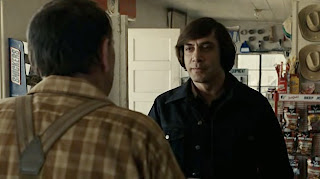
BEST OF THE DECADE - #3: No Country For Old Men

No Country For Old Men (2007): Written and directed by Joel and Ethan Coen, based on the novel by Cormac McCarthy. Starring: Tommy Lee Jones, Javier Bardem, Josh Brolin. Rated R (strong graphic violence and some language). Running time: 122 minutes.

**NOTE: This review freely discusses the final scenes of the film, so be forewarned of spoilers.

Strange, that after three viewings, I’m still at a loss to identify what exactly No Country For Old Men is. The main storyline featuring Llewelyn Moss’s (Josh Brolin) discovery of $2 million in drug money and killer Anton Chirgurh’s (Javier Bardem) subsequent pursuit of him are the makings of a fine crime thriller. Sheriff Ed Tom Bell’s (Tommy Lee Jones) investigation adds an element of a police procedural to film, but after much of the main action concludes, the film curiously stays with him for an additional 20 minutes. If you ask the Coen Brothers, they’d call the film a comedy, but perhaps it’s more of an absurdist drama, a comment on the randomness of crime and violence. Its lack of a clear identity is one of its mysteries, and in attempting to identity the parts of No Country, one begins to get at its intent.

The film is set near the Texas/Mexico border in 1980, when drug-related violence was at a peak from illegal trades across the border. However, if not for specific time markers, we might think the film is set in a post-apocalyptic world. In one scene, as Moss runs on foot from a group of Mexican drug dealers, a bolt of lightning splits the sky. Another scene sets a gritty standoff in an eerily quiet street that only offers parked cars as cover. Jones’s aged Sheriff Bell explains in his opening monologue, he doesn’t know what time make of this new world’s crime. The darkness and brutality of the violence he’s faced with has no logic or reasoning, and it appears to him that the world around him is becoming just as bleak.

Anton Chigurh presents himself as a product of this environment, and his identity is a mystery in itself. Bell thinks he’s a ghost. Or is he an incarnation of Death? Both theories are refuted in one scene that shows him bandaging a gunshot wound, revealing him to be very much human. Still, Chigurh views himself as more of a force than a man. For him, the murders he commits are not his choice, and he decides people’s fates by a coin toss. “I got here the same way the coin did,” he says. He is simply facilitating our eventual deaths. There is no systematic technique to his killings – he is not a serial killer in this sense – but he does retain a consistent tone and attitude. In several scenes, he speaks calmly to his potential victims, telling one man to “Hold still” and inquiring into another man’s family life. In others, he acts quickly and efficiently, and the Coen Brothers do not cut away from these killings. In this sense, the camera is as unflinching as Chigurh is. If the violence feels gratuitous, Sheriff Bell shares your view.

As the characters move through this bleak world, the pace remains methodical, and there is barely any musical score, with several sequences presnted in near silence. As a result, these scenes take on a chilling, sober air, and we find ourselves drawn to them with an almost animalistic fascination as Llewelyn fights for survival. The dialogue is minimalistic, and though the Coen Brothers claim to have simply opened up Cormac McCarthy’s novel and transcribed the dialogue, the pacing and delivery of it are decidedly Coen-esque. Watch how Javier Bardem takes the time to chew cashews in between lines of the first coin toss scene and raises his eyebrows to emphasize a point just before leaving. Later, a frank exchange between Llewellyn, dressed only a hospital gown, and a salesman elicits a laugh when the man states that, “It’s unusual” for a customer to come in without clothes on. These touches of humor and strangeness seep into the film without ever disturbing the film’s solemnity.

One of the main sources of mystery surrounding the film comes from what at first appears to be an extended epilogue after the main action has ended. The focus is redirected to Bell as he struggles to understand the world he is now a part of, ultimately conceding that he has neither the strength nor the will to actively fight back. A conversation with his uncle, a retired sheriff, convinces him this resignation is for the best; the evil forces in the world are too much for him. The scene that follows presents the film’s only glimmer of hope, a meeting between Llewelyn’s wife, Carla Jean (Kelly Macdonald) and Chigurh, who she finds in her home. When asked to call Chigurh’s coin toss, she refuses, stating that the coin has no say. Her resistance to Chigurh’s game expresses a belief that the world, Chigurh included, does not need to be the way it is. The scene cuts before we see his actions, but he checks the soles of his shoes in the next shot, and we know from a previous scene where he lifts his feet from a spreading pool of blood that he has killed her. The film returns to Bell for the final scene, ending with his recounts of two dreams featuring his father. He explains how his father never saw these times, and perhaps he wishes he hadn’t either. Reinforcing the theme of changing times is the sound of a clock in the background that is heard after the cut to black and into the credits. In the dream, Bell’s father is “going on ahead” to build a fire in the dark, perhaps a sanctuary in the afterlife of some sort, and in time, Bell will be joining him.

No Country For Old Men is a virtually perfectly edited film; nothing unnecessary is said or shown. It showcases the peak of the Coens’ craftsmanship, every shot a beautiful visualization of McCarthy’s bleak world, every character, no matter how minor, a fleshed out individual. It is a film that exists outside strict genre identity, delivering a potent and uncompromising take on a brutal and violent country.

- Steve Avigliano, 2/10/10